Congratulations to all the following who sent in very good solutions to this
problem:
David Lowe, age 15, Trinity School, Carlisle (whose solution was the first to
arrive); Babak Shirazi, age 17, Woodhouse SF College, London; Chen Yiwen, age 16,
The Chinese High School, Singapore; Nathan Allpress, age 14, Riccarton High
School, Churchtown, New Zealand; Lee Jia Hui, age 18, National Junior College,
Singapore; Julian Steed (not a student); and finally Alexander Maryanovsky,
age 18, Shevah-Mofet School, Israel. The following solution is made up of bits
supplied by several of these contributors.
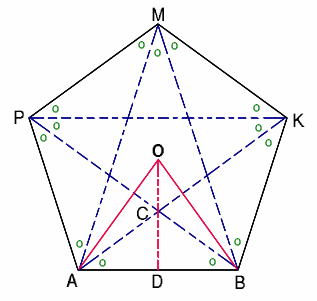
The pentagon is made of 5 triangles exactly the same as AOB, and the pentangle
is made of 5 shapes exactly the same as AOBC.
|
| |
|
Area(pentangle)
Area(pentagon)
|
|
|
|
| |
|
| |
|
| |
|
| |
|
|
|
In order to calculate this ratio exactly we first find the angles and then use
trigonometry.
As AC is parallel to PM and CB is parallel to MK,
|
| |
|
Area(pentangle)
Area(pentagon)
|
|
|
|
| |
|
| |
|
| |
|
| |
|
| |
|
|
|
This ratio is just less than 0.5 meaning the pentangle is a bit smaller than
half the pentagon.
Footnote: You don't need a calculator, from the diagram it is possible
to calculate exact values for the trig. ratios
for 18° , 36°, 54° and 72°. All the angles marked
with a spot can be shown to be 36° using simple properties of triangles.
Let CA=CB=x. The triangle PAC is an isosceles triangle with base angles of
72°. If PA=PC=1 then PB=1+x. Triangles PAB and ACB are similar,
hence
This gives a quadratic equation which can be solved to give
Now we have AD=1/2 and so (using Pythagoras Theorem to find CD):
|
tan2 36° = 4CD2 = 4(x2 - |
1
4
|
) = 4x2 - 1 = 5 - 2Ö5. |
|