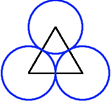
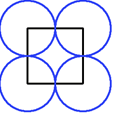
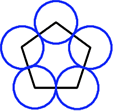
For any regular polygon it is always possible to draw circles
with centres at the vertices of the polygon, and radii equal to
half the length of the edges, to form a "polycircle" in which
each circle just touches its neighbours.
Investigate and explain what happens in the case of non-regular
polygons. Is it always possible to construct three circles with
centres at the vertices of the triangle so that the circles just
touch?
Try a numerical example, say the 3 points give a triangle of
sides 12, 15 and 13. Find the radii of the circles.
Now use the same method when the sides of the triangle are $a$,
$b$ and $c$.
Generalise still more! What about 4 circles? 5 circles? $n$
circles?
Experiment with the interactivities below or do the construction
for yourself with ruler and compasses or using dyanamic geometry
software.
The next applet is a 5-sided polygon. Again you can check that
wherever you move the vertices off the polygon, the circles
centred at those points will remain tangent to their two
adjacant circles. Can you calculate the radii given the lengths
of the sides of the polygon?
In the final applet below we have a quadrilateral. Here you
see that there are 4-sided polygons where the 4 circles are not
all tangent to one another. Can you make the red and green
circles lie on top of one another? Then you have made all the
circles tangent to their neighbours.
Created with GeoGebra
For the final challenge, what is the locus of the centre of the
red and green circles when it moves so that these circles are
coincident, always touching their neighbours, maintaining a
perfect polycircle?
To investigate this problem further, download a copy of
GeoGebra and experiment
for yourself. Geogebra is free educational mathematics software
that is very easy to use and combines dynamic geometry,
coordinate geometry, algebra and calculus. You can also
download the
Quickstart guide for beginners.