Jane noticed the patterns in the not
tilted triangles:
They are square numbers, the little one is area $1$, then area
$4$, then $9$ going up in size accross the given image.
This is surprising as they are areas of triangles, and they are
giving square numbers. You can calculate the size of a triangle
by counting the length of a side and squaring it.
Esther deduced the following after
looking at lots of examples of tilted triangles.
The formula for the area of a tilted triangle is based around
$n^2$.
If the amount of tilt is $x$, and the place in the sequence is
$n$, the area is $n^2 +xn +x^2$ triangular units.
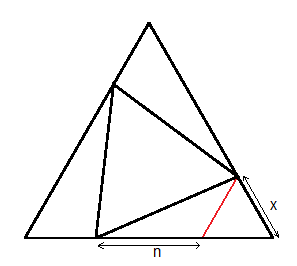
Adele from Coventry High School used
the image below to prove Esther's conjecture:
We have that $x$ is the tilt of the small triangle. So the
edge length of the big triangle is $2x+n$, so the area is
$(2x+n)^2$ from Jane above.
We then want to find the area of the bits between the big and
little triangles.
So if we look just in the bottom right of the picture as the
three sections are the same.
We have an equilateral triangle in the corner with edge
length $x$, so that area is $x^2$.
For the area of the other triangle, we cannot use standard
formula for area as we have unit tiangles rather than unit
squares. If we look at that area on the isometric paper we
get a parallelogram with edges $n$ and $x$, which means the
parallelogram has area $2nx$ because of the isometric nature.
The area of that scalene triangle is then $nx$, so the whole
thing is $nx+x^2$.
The area of the little triangle is
$A=(2x+n)^2-3\times (nx+x^2)$
$A=4x^2 + 4nx + n^2 - 3nx - 3x^2$
$A=x^2 + nx + x^2$
So Esther was right.