Dave cracket this toughnut for us using
position vectors! Well done! You might like to consider whether
the result holds in three dimensions when the five given points
are not coplanar.
Consider the pentagon:
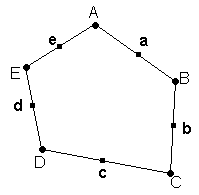
We can obtain 5 simultaneous equations:
2a =A+B
2b =B+C
2c =C+D
2d =D+E
2e =E+A
Solving these equations gives:
A=a -b +c -d +e
Similar formulas for B, C, D and E are also obtained.
Note this formula can also be written as:
A=c +(e -d )+(a -b )
So if we start at C, then construct a line of the length of the
line from e to
d parallel to it,
starting from c , then a
line starting from the previous point the same length and
direction as the line from b to a , then this final point will be
A.
But how do you construct a
parallel line through a point z, parallel to the line through x,
y and the same length?
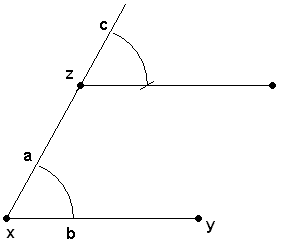
Draw a line connecting x
to z and beyond, then
draw a circle with radius less than the distance to z , centred on x . Draw a circle with the same
radius centred on z. Now set the compass to the length from a to
b, and raw a circle about c with this radius. Now if you draw a
line through where this circle intersects our previous circle,
you will have a line through z parallel to the line through
x and y . Finally, to get the length
correct, set the compass to the length from x to y , and draw a circle of this radius
about z . The
intersection with the line gives the endpoint.
In the case of a general odd-sided shape, the formula will just
be:
and similar formulas will apply for all the other points. by
the same factorisation as above, a combination of lines can
again be used to find each point.
If we have an odd number of sides, when we try and solve the
equations we find:
If this is true, then we can solve the problem form even-sided
shapes, although there will be multiple possible solutions this
time - we can choose one of the verticies to be whatever we
like!