This solution is from David Lowe, age 16, from Trinity School,
Carlisle, Cumbria.
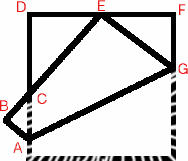
A square is folded so that the corner E coincides with the
midpoint of an opposite edge as shown in the diagram. The length of
the edge of the square is 1 unit and the problem is to find the
lengths and areas of the three triangles.
David uses trigonometry but alternatively, once you have found
the dimensions of triangle EGF you can find all the other lengths
and areas using the fact that the triangles EGF, CED and CAB are
similar 3:4:5 triangles.
The table shows the solutions:
| Triangle |
Lengths of sides
3 : 4 : 5 |
Ratio of lengths
in 3 triangles |
Area |
Ratio of areas
of 3 triangles |
| EGF |
3/8 : 1/2 : 5/8 |
3 |
3/32 |
9 |
| CED |
1/2 : 2/3 : 5/6 |
4 |
1/6 |
16 |
| CAB |
1/8 : 1/6 : 5/24 |
1 |
1/96 |
1 |
This is David's method:
The edge, EF = 1/2. Taking FG = a then GE = 1−a
As it has a corner of the paper as part of it, we know EGF is a right
angled triangle, and so GE2 = EF2 + FG2, which gives
so
Now that we have the length of a we have the lengths of all the sides of
this triangle: EF = 1/2 , FG = 3/8 and GE = 5/8.
The area of triangle EFG = 1/2 base × height = 3/32.
Using this information and trigonometry, we can work out the angle GEF:
∠GEF = tan−1(0.375 / 0.5) = tan−10.75 = 36.9°.
taking the angle to the nearest tenth of a degree.
Knowing this, we can work out the angle DEC=53.1° and use it with
the length DE to work out the length DC=2/3.
The last part needed of this triangle is CE and, using
Pythagoras theorem, we get CE = 5/6.
So DE = 1/2, DC = 2/3, CE = 5/6
and the area of triangle DEC = 1/2 ×2/3 ×1/2 = 1/6.
The last triangle needed is ABC. We know the length
BC = 1 − CE = 1/6.
We can also work out the angle BCA which is equal to angle DCE and to angle FEG.
We can now use trigonometry to work out the length
AB = 1/6 tanBCA = 1/8.
And so once again, using Pythagoras, we can work out the length of line
AC which is 5/24.
And so we have the final set of lengths:
AB = 1/8, BC = 1/ 6 and AC = 5/24.
The area of triangle ABC = 1/2 ×1/8 ×1/6 = 1/96.
This means the total area of all the paper with a single thickness =
26/96 = .270833..
This can be backed up by working out the area of the trapezium ABEG,
subtracting the area of triangle ABC and then multiplying the result by
2 to give the area of the original square that is now double thickness.
Area of trapezium = 1/2 [1/8 +5/8] ×1 = 3/8.
Double thickness area = 3/8 − 1/96 = 35/96.
The total area is 2 ×35/96 + 26/96 = 1
and so all areas are worked out and recorded, and the total area of
single thickness paper and double thickness areas are recorded.