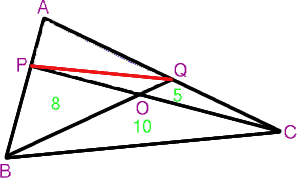
Sue of Madras College sent in two solutions to this problem which both use the same method. In this one she divides the quadrilateral into two triangles by joining $PQ$ and in the other solution she divides the quadrilateral into triangles by joining $AO$.
As $\Delta BOC$ and $\Delta OQC$ have the same height their areas are in the same ratio as their bases, that is $$ {BO\over OQ} = {10\over 5} = 2.$$ Similarly, $\Delta BOP$ and $\Delta OQP$ also have the same height, so their areas are in the ratio $${\Delta BOP\over \Delta OQP} = {BO\over OQ} = 2.$$ Hence $$\Delta OQP = 8/2 = 4.$$ Let the area of $\Delta APQ = x$, then $${AQ \over QC} = {\Delta ABQ \over \Delta QBC} = {x + 12 \over 15}$$ but $${AQ \over QC} = {\Delta APQ \over \Delta QPC} = {x \over 9}.$$ So $${x + 12 \over 15} = {x \over 9}$$ $$9x + 108 = 15x$$ Hence $x = 18$ and the area of the quadrilateral $APOQ$ is 22 square units. The same argument could be applied to the side $AB$.