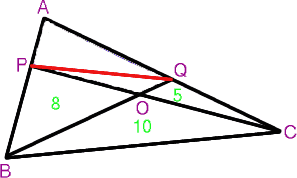
Sue Liu, S5, Madras College sent in two solutions to this problem which both
use the same method. In this one she divides the quadrilateral into two
triangeles by joining PQ and in the other solution she divides the
quadrilateral into triangles by joining AO.
As ∆BOC and ∆OQC have the same height their areas are in the same ratio as their bases, that is
BO
OQ
=
10
5
= 2.
Similarly,
∆BOP and ∆OQP also have the same height, so their areas
are in the ratio
∆BOP
∆OQP
=
BO
OQ
= 2.
Hence
∆OQP = 8/2 = 4.
Let the area of ∆APQ = x, then
AQ
QC
=
∆ABQ
∆QBC
=
x + 12
15
but
AQ
QC
=
∆APQ
∆QPC
=
x
9
.
So
x + 12
15
=
x
9
9x + 108 = 15x
Hence x = 18 and the area of the quadrilateral APOQ is 22 square units.
The same argument could be applied to the side AB.