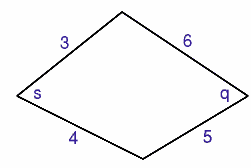
To crack this tough nut you will need to use the sine and cosine rules. Four rods are
hinged at their ends to form a convex quadrilateral with sides of length 3, 4, 5 and 6.
The question states that the quadrilateral is convex; this means that the angles
and
are at most 180 degrees. Imagine moving the rods to make the
angle
as large or as small as possible. Find the largest and smallest values
of
and
.
Suppose the angle
is 60 degrees, then it is easy to calculate the length
of the diagonal and from it all the angles in the diagram. You might like to check
your answer by drawing the quadrilateral accurately, using ruler and compasses only,
and then measuring the angles.
To calculate the angles of the cyclic quadrilateral formed by keeping the lengths of
the sides the same and changing the angles so that opposite angles add up to 180 degrees
you simply need to use the fact that, in this case,
.
Congratulations to Katharina Jurges from the International School in Strasbourg and to Chris Hardstaff from Heckmondwike Grammar School for their solutions to Bendy Quad. Here is Katharina's solution:
To solve this problem I only used one formula which is called the Al Kashi theorem
in the country I go to school (France). It is actually an extension
of Pythagoras' theorem and is true for every triangle, rectangular or not:
where a is the side opposite to the vertex A and k the angle at A; b and c are the two other sides of the triangle. By transforming it one obtains:
|
|
First part (convex quadrilateral):
Note
,
,
are the other three angles in the quad
is formed by sides 4 and 5 (i.e. the sides with the lengths 4 and 5),
is formed by the sides 5 and 6, and r by the sides 6 and 3).
Note
the diagonal opposite to the angle of 60. Using the first equation,
one finds
equals the square root of 13. Now it is easy to calculate the
other angles, although one has to calculate
and
by first calculating
the two parts of each angle because they are cut by the diagonal
.
I just give the approximate values for the angles:
|
|
Second Part (cyclic quadrilateral):
I use the same notations as before and note s to be the angle which measured
in the first part.
and
are opposite angles (in a cyclic quadrilateral), therefore
.
According to the Al Kashi theorem:
|
|
Thus one can calculate
, then
,
, and the other
two angles which must be calculated "by parts" once again (as in the first part).
I give the approximate values for the four angles and d:
|
|