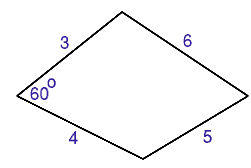
| {\bf First part (convex quadrilateral with 60 degree
angle):} \\ According to the Al Kashi theorem: $$3^2 + 4^2
-24\cos s = d^2 = 5^2 +6^2 - 60\cos q$$ which simplifies to
give $$2\cos s + 3 = 5\cos q.$$ As $\cos s = 0.5$ this
gives $\cos q = 0.8$ and $q = 36.9^o$ \par To calculate the
other angles, use the Sine Rule to find the two parts of
angle $p$ and of angle $r$ cut by the diagonal $d = \sqrt
13$. $ p =132.9^o$ and $r =130.2^o$ (to 1 decimal place).
|
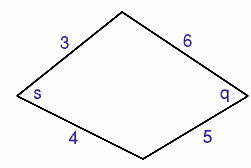 |
Second Part (cyclic quadrilateral): We have found For a cyclic quadrilateral so . Hence so that and . By drawing the other diagonal and using the same method we find that which gives So giving and . |