Both Sue Liu, Madras College, St Andrews and Vassil Vassilev, Lawnswood High School,
Leeds solved this one, well done!
Triangle ABC has altitudes h1, h2 and h3. The radius of
the inscribed circle is r, while the radii of the escribed circles
are r1, r2 and r3. We prove that
1
r
=
1
h1
+
1
h2
+
1
h3
=
1
r1
+
1
r2
+
1
r3
.
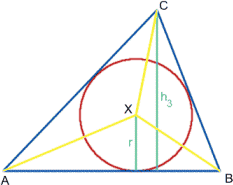
Let ∆ be the area, of the triangle ABC and let X be the centre of the
inscribed circle.
Clearly,
∆ = 1/2r.AB+
1
2
r.BC+
1
2
r.CA,
so that
1
r
=
AB + BC + CA
2∆
.
Also,
∆ = 1/2h1.BC = 1/2h2, CA = 1/2h3.AB,
thus
1
h1
+
1
h2
+
1
h3
=
BC + CA + AB
2∆
=
1
r
.
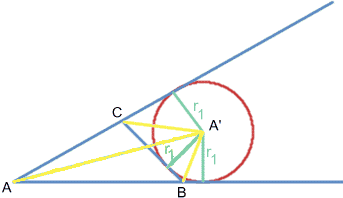
Now let A ' , B ' and C ' be the centres of the escribed circles;
see the diagram below.
Also, for any triangle with vertices U, V and W,
let ∆(U,V,W) denote its area.
Considering the area of the kite ABA ' C by splitting it into two triangles
in two different ways we get