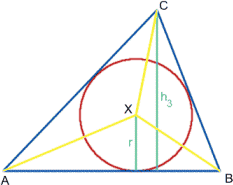
Clearly,
D = 1/2r.AB+ 1
2
r.BC+ 1
2
r.CA,
so that
1
r
= AB + BC + CA
2D
.
Also,
D = 1/2h1.BC = 1/2h2,     CA = 1/2h3.AB,
thus
1
h1
+ 1
h2
+ 1
h3
= BC + CA + AB
2D
= 1
r
.
Now let A¢, B¢ and C¢ be the centres of the escribed circles; see the diagram below. Also, for any triangle with vertices U, V and W, let D(U,V,W) denote its area. "


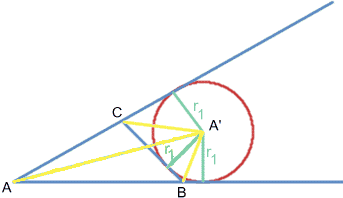
Considering the area of the kite ABA¢C by splitting it into two triangles in two different ways we get
D(A,B,C)+D(B,A¢,C) = area(ABA¢C) = D(A,B,A¢) + D(A,C,A¢).
This gives (with D = D(A,B,C))
D+1/2r1.BC = 1/2r1.AB + 1/2r1.CA,
and hence
2D
r1
= AB + CA - BC.
Similarly,
2D
r2
= AB + BC - CA,     2D
r3
= CA + BC - AB,
and adding these we get
2D æ
ç
è
1
r1
+ 1
r2
+ 1
rC
ö
÷
ø
= (AB + CA - BC) + (AB + BC - CA) + (CA + BC - AB)
= (AB + BC + CA)
= 2D
r
as required.