Congratulations on your solutions to Ian Walker, Owen Jones and Tom
Embury (Y7) St James Middle School, Bury St Edmunds, to students from Y9 and
Y10, The Mount School, York and to Shabbir Tejani, age 13, Jack Hunt School,
Peterborough. Here is Shabbir's solution:
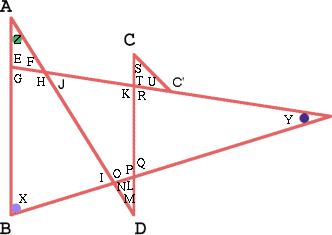
Angle G = 180 - (angle Y + angle X)
Angle E = 180 - angle G
Angle F = 180 - (angle E + angle Z)
Angle J = angle F
Angle H = 180 - Angle F
Angle I = 360 - (angle X + angle H + angle G)
Angle O = 180 - angle I
Angle N = 180 - angle O
These are all the angles that can be found without additional information. If
we are given the added information that the lines AB and CD are parallel then
we know:
Angle M = angle Z
Angle L = 180 - (angle M + angle N)
Angle P = 180 - angle L
Angle K = 180 - angle G
Angle Q = 180 - angle P
Angle R = 180 - angle K
Angle T = 180 - angle R
Angle S and U cannot be found.
HOWEVER if lines CC' and AD are parallel, then angle M = angle S. Therefore
Angle U = 180 - (angle S + angle T)