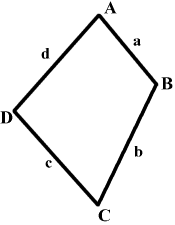
Four rods are hinged at their ends to form a convex quadrilateral with fixed side lengths. Show that the quadrilateral has a maximum area when it is cyclic. Sue Liu, S5, Madras College, St Andrews used two methods to solve this.

First she applied Brahmagupta's formula for the area of a quadrilateral.


δ =


(sa)(sb)(sc)(sd) − abcd cos2 β
 

where
s =  1

2
(a + b + c + d)

and
β =  1

2
(A + C)

or
 1

2
(B + D)

.

Hence the area is clearly the greatest when abcd cos2 β is least. Since cos2 β is always positive, this value is least when β is 90 degrees as cos90o = 0. Hence
 1

2
(A + C) = 90

and so A + C = 180 showing that the opposite angles in the quadrilateral add up to 180o and so the area of a quadrilateral with fixed lengths of sides is greatest when it is cyclic.

This method gives a proof of the required result but you have to assume Brahmagupta's formula and Sue's second method uses only the formula for the area of a triangle.

The area of the quadrilateral ABCD can be expressed as the sum of the areas of triangle ABD and BCD. Let the area of ABCD be ∆ then
∆ =  1

2
adsinA +  1

2
bc sinC

from which
2∆ = adsinA + bc sinC
.

Squaring gives
4∆2 = a2d2sin2 A + 2 abcd sinA sinC + b2 c2 sin2 C     (1)

Also, we notice that (using the cosine rule for the length of the diagonal DB)
a2 + d2 −2ad cosA = b2 + c2 − 2bc cosC

or written differently


a2 + d2b2c2 = 2ad cosA − 2bc cosC + 4b2c2 cos2 C    (2)
Now we see a similarity with equation (1). If we multiply equation (1) by 4 and add equation (2) we get


2 + (a2 + d2b2c2)2
=
4 a2d2(sin2A + cos2 A)
+4b2c2(sin2C +cos2C)
− 8abcd(cosA cosC − sinAsinC).     (3)

We know that sin2 α+ cos2 α = 1 and the compound angle formula
cos( α+ β) = cosαcosβ− sinαsinβ

for all α, β, it follows that (3) becomes


16∆2 + (a2 +d2b2c2) = 4a2 d2 + 4b2 c2 − 8abc cos(A +C)

since a,  bcd are all fixed, it follows that ∆ is largest when cos(A + C) is the smallest, that is, when cos(A + C) = −1. Hence the area is largest when A + C = π. So the area of the quadrilateral is largest if it is cyclic.

A variant of this method is to use the formula for the area, then
 d

dA
=  1

2
adcosA +  1

2
bccosC  dC

dA

and from the cosine rule


2ad sinA = 2bc sinC  dC

dA
Hence
 d

dA
=
 1

2
adcosA + ad cosC  sinA

sinC
=
 1

2
ad (cosA sinC + sinA cosC)
=
 1

2
ad sin(A + C).

Hence, for the maximum area, sin(A + C)=0 and A+C=π which makes the quadrilateral cyclic.