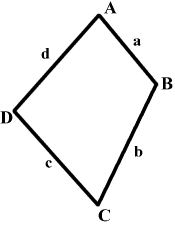
 Hence the area is clearly the greatest when
is least.
Since
is always positive, this value is least when
is 90 degrees as
. Hence
and
so
showing that the opposite angles in the quadrilateral add up
to
and so the area of a quadrilateral with fixed lengths of sides is
greatest when it is cyclic.
This method gives a proof of the required result but you have to assume
Brahmagupta's formula and Sue's second method uses only the formula for the
area of a triangle.
METHOD 2
Hence the area is clearly the greatest when
is least.
Since
is always positive, this value is least when
is 90 degrees as
. Hence
and
so
showing that the opposite angles in the quadrilateral add up
to
and so the area of a quadrilateral with fixed lengths of sides is
greatest when it is cyclic.
This method gives a proof of the required result but you have to assume
Brahmagupta's formula and Sue's second method uses only the formula for the
area of a triangle.
METHOD 2