Sue Liu of Madras College, St Andrew's sent a solution to this
problem which depends on the use of Heron's Formula for the area of
a triangle. Here is Sue's method.
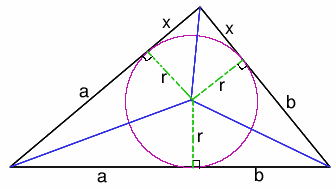
The incircle divides the sides of the triangle into lengths
,
and
as shown in the diagram. The semi-perimeter
of the triangle is given by
and from Heron's formula
the area of the triangle is
|
|
Also, the triangle is divided into three smaller triangles and the
total area is given by
|
|
Equating the two answers
|
|
Hence
|
|
An alternative method, not using Heron's formula, is based on finding x in
terms of
and
using the tangents of the angles at the centre of the
circle.