Eduardo from the British School,
Manila, Tomas from Malmesbury School and Philip used the tangent
formula and Alex and also Sue Liu of Madras College, St Andrew's
sent a solution to this problem which depends on the use of
Heron's Formula for the area of a triangle. Well done all of
you.
 |
FIRST METHOD
Using the tangents of the angles at the centre of the
circle and the formula
$\tan X= -\tan(A + B) =\frac{\tan A + \tan B} {\tan A
\tan B - 1} $ where $A + B + X = 180^o$,
$\frac{x}{r}=
\frac{\frac{a}{r} + \frac{b}{r}}{\frac{ab}{r^2}-1} =
\frac{r(a + b)}{ab - r^2}.$
The area of the triangle is
$(a + b + x)r = (a + b)r + \frac{r^3(a + b)}{ab - r^2}=
\frac{(a + b)abr}{ab - r^2}$ as required.
|
SECOND METHOD
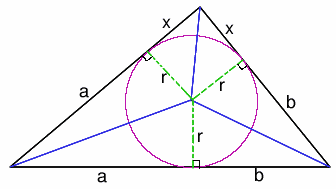
This method uses Heron's formula. The lines from the centre of
the circle to the edges each meet the tangents to the circle
forming right angles as shown. The triangle has been
rotated/reflected so that the side with length (a+b) is the base.
(However it is rotated it is the same shape of unknown angles and
lengths). As the tangents to a circle from an external point are
equal in length (easily proved using congruent triangles) the
other lengths of the sides of the triangle can be found. The
incircle divides the sides of the triangle into lengths $c' = a +
b$, $b' = b + x$ and $a' = x + a$ as shown in the diagram.
The semi-perimeter of the triangle is given by $s = x + a + b$
and from Heron's formula the area of the triangle is
$A = \sqrt{(s(s - a')(s - b')(s - c'))}$
$= \sqrt{((a + b + x)abx)} $
Also, the triangle is divided into three smaller triangles and
the total area is given by
$ A = \frac{1}{2}(a + b)r + \frac{1}{2}(b + x)r + \frac{1}{2}(x
+ a)r $
$=(a + b + x)r $.
Equating the two answers
$ \sqrt{abx(a + b + x)} = (a + b + x)r $
$ abx(a + b + x) = (a + b + x)^2 r^2 $
$ abx = (a + b + x)r^2 $
$x = \frac{(a + b)r^2}{ (ab - r^2).} $
Hence
$ A = (a + b + x)r$
$ = \frac{r((a + b)(ab - r^2) + (a + b)r^2)}{ ab - r^2}$
$ = \frac{abr(a + b)}{ab - r^2.} $
An alternative method, not using Heron's formula, is based on
finding $x$ in terms of $a$ and $b$ using the tangents of the
angles at the centre of the circle.