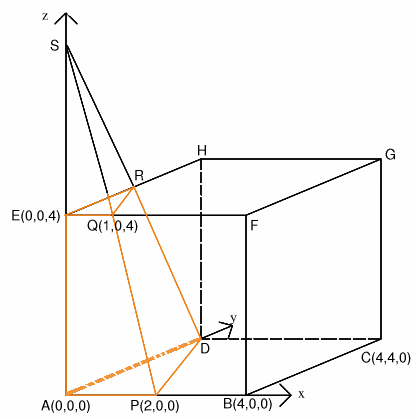
This problem was solved by Brad Rodgers, age 14 of Kokomo School, India and Sue Liu of Madras College, St Andrews.
Using 3D coordinates with point A at the origin, B being the point (4, 0, 0),
C the point (4, 4, 0), D the point (0, 4, 0), E the point (0, 0, 4) etc as
shown in the diagram. The point P which is the midpoint of AB has coordinates
(2, 0, 0) and Q, which is a quarter of the way along EF has coordinates
(1, 0, 4).
The general equation of a plane is ax + by + cz = 1 and to find a, b
and
c we only need to know three points in the plane. Hence
it is easy to find the equation of the plane through D,
P and Q. Substituting the coordinates of the points into the equation
of the plane we get:
4b
=
1
2a
=
1
a + 4c
=
1
This gives a = 1/2, b = 1/4 and c = 1/8. Writing the equation of the
plane without fractions we get
4x + 2y + z = 8.
The point R where the
plane cuts the line EH has coordinates (0, y, 4) where 0 + 2y + 4 = 8
so R is the point (0, 2, 4).
Now RE = 2, EQ = 1, ∠ REQ = 90°,
and DA = 4, AP = 2, ∠ DAP = 90° so it follows that the
triangles REQ and DAP, which lie in parallel planes, are similar. Also,
if we extend the lines AE, PQ and DR they will meet at one point S
where SE = 4 and SA = 8.
The points S, A, P and D are the vertices of a tetrahedron which is sliced into two parts by the plane through R, E and Q. The required volume of the section
of the cube is given by subtracting the volume of the tetrahedron SEQR from the volume of the tetrahedron SAPD.
Volumeofsmallersectionofcube =
1
3
(32 − 4) =
28
3
.
The volume of the whole cube is 64 cubic units so the ratio of the volume of the smaller piece to the volume of the cube is 7 to 48. The ratio of the volumes of the two pieces of the cube is 7 to 41.