The problem can be solved, without using 3D coordinates, by
essentially the same argument as the one used in the solution
below. You have to locate the same points, and use similar
triangles and the volumes of similar tetrahedra.
This solution came from Brad of Kokomo School, India and very
similar solution from and Sue Liu of Madras College, St Andrews.
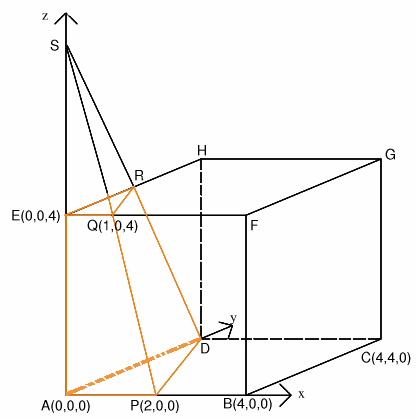
Using 3D coordinates with point A at the origin, B being the point (4, 0, 0),
C the point (4, 4, 0), D the point (0, 4, 0), E the point (0, 0, 4) etc as
shown in the diagram. The point P which is the midpoint of AB has coordinates
(2, 0, 0) and Q, which is a quarter of the way along EF has coordinates
(1, 0, 4).
"
The general equation of a plane is
and to find
,
and
we only need to know three points in the plane. Hence
it is easy to find the equation of the plane through D,
P and Q. Substituting the coordinates of the points into the equation
of the plane we get:
This gives
,
and
. Writing the equation of the
plane without fractions we get
The point R where the
plane cuts the line EH has coordinates (0, y, 4) where
so R is the point (0, 2, 4).
Now RE = 2, EQ = 1,
,
and DA = 4, AP = 2,
so it follows that the
triangles REQ and DAP, which lie in parallel planes, are similar. Also,
if we extend the lines AE, PQ and DR they will meet at one point S
where SE = 4 and SA = 8.
The points S, A, P and D are the vertices of a tetrahedron which is sliced into two parts by the plane through R, E and Q. The required volume of the section
of the cube is given by subtracting the volume of the tetrahedron SEQR from the volume of the tetrahedron SAPD.
The volume of the whole cube is 64 cubic units so the ratio of the volume of the smaller piece to the volume of the cube is 7 to 48. The ratio of the volumes of the two pieces of the cube is 7 to 41.