Trish and James sent us in their
solutions:
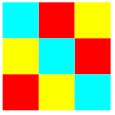
We put all the blues on the diagonal, so none of them were
touching, and then we put a red in one corner and a yellow in the
other so they weren't touching and then we had to put the other
colours where they are. Then we did the same with a red diagonal
and a yellow diagonal:
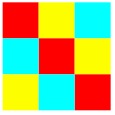
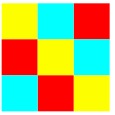
A great way of working out some
possible results!
Then Danny told us how he worked out how
many possible combinations there were:
First I worked it out
starting with blue in the top left corner and red next to it in
the top middle.
There are six different ways of starting (blue then red, blue
then yellow, red then blue, red then yellow, yellow then red,
yellow then blue) so there will be six times as many answers as I
got starting with blue then red. This is because if I take one
answer and swap all the blues for yellows and yellows for blues I
get another answer, and there are six different ways to swap the
colours.
The two square below the starting two can be yellow then blue,
red then blue or red then yellow. That way I had three different
ways the top left 2 x 2 squares could be coloured.
Then I worked out how many different ways you can colour in the
top right and middle right squares.
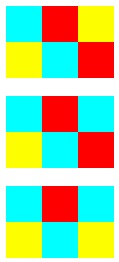
There are three ways for each of the different starting 2 x 2
squares. For instance for the starting 2 x 2 with yellow then
blue on the second row, you can have:
Then I worked out how many ways the bottom left and bottom middle
squares can be coloured. There are three ways for each of the
different 2 x 3 top blocks, but some of them use too many blues
or reds.For instance:
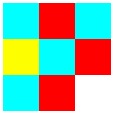
uses too many blues. There are ten different ways of filling in
all but the bottom right square, and then this one must be
whatever square you've only used twice before. So there are ten
different ways starting with blue then red, so there must be
sixty different ways altogether.
Thank you, Danny!