Two very good solutions were sent in from Madras College, St
Andrews by Dorothy Winn and Hannah Bredin.
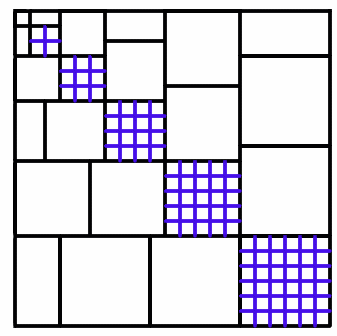
Imagine cubes on each of the squares marked with a blue lattice,
a diagonal line of cubes of increasing size. Then take away all the
layers except the bottom ones and spread them out, dividing them
into two groups and arranging them to cover the whole square.
Start with one cube. Then make a 3 x 3 x 1 layer by
breaking the top layer of a 2 x 2 x 2 cube in half and
putting the halves on the edges. This shows that 1
3 + 2 3 = (1 + 2) 2.
Then make a 6 x 6 x 1 layer by separating the
layers of a 3 x 3 x 3 cube and putting the top two
layers along the edges. This shows that 1 3 + 2
3 + 3 3 = (1 + 2 + 3)
2.
The pattern should continue. The diagram shows how
1 3 + 2 3 + 3 3 + ... + 6
3 = ( 1+ 2 + 3 + ... + 6) 2.
To prove the pattern continues indefinitely, suppose we add a new cube of side
length k on the
bottom right hand corner. Take (k − 1) layers off
and divide into 2 so we have (k − 1)/2 layers of size
k ×k ×1 to be placed along two edges. Notice that if
k is odd then (k − 1)/2 is a whole number and if
k is even then (k − 1)/2 is the whole number (k − 2)/2 plus
one half so one of the layers has to be
split in half.
To find the side length L of the 'new' square,
multiply (k − 1)/2 by k to give the total length of these
pieces added along the edges and add k for the length of the side
of the original base of the cube
which is being broken up.
Thus if we have k cubes then the length of the sides of the large
square is given by the formula
Hence
|
13 + 23 + 33 + ... + k3 = (1 + 2 + 3 + ... + k)2. |
|
Footnote.
The formula for the sum of the first k whole numbers is given by
or equivalently by
|
Sk = k + (k − 1) + (k − 2 ) + ... + 1 |
|
and by adding this series to itself we get
.