Jenny writes:
An argument might go something like this: Let's assume I can make
an icosahedrons with 3 red vertices but no vertex has 2 red
neighbours. First, I mark any vertex red and call it A (see the
diagram), I can now think of the icosahedrons as made up of 4
layers of vertices.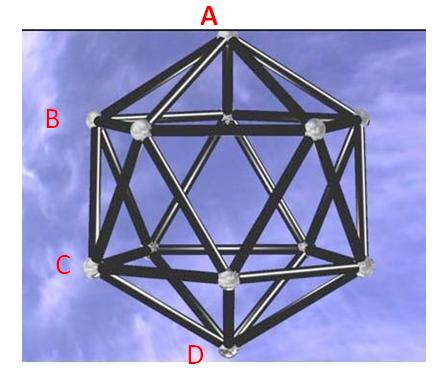
- The one I marked at the top, which is A
- The ring of 5 vertices adjacent to A, call it B
- The ring of 5 vertices below ring B, call it C
- The vertex that is adjacent to ring C, call it D
Since A is red, I cannot now mark any of the vertices on B red
because there will be a third vertex adjacent to this vertex and A
so that it has 2 red neighbours. So let me put a second red vertex
on the ring C, now there will always be a vertex on the ring B with
two adjacent red vertices. Thus, I cannot mark any of the vertices
on C red. The only place left for the second red vertex is the
vertex D.
Now I have to place a third vertex on the ring B or C but I have
shown that by putting one there I can find a vertex with 2 red
neighbours.
Therefore it is not possible to have 3 red vertices without at
least one vertex having 2 adjacent red vertices.
Steve writes:
Suppose that three vertices are coloured red and that no vertex has
more than one red neighbour. Because no vertex can be adjacent to
two red vertices we can see that no two red vertices can be on the
same triangular face or on two adjacent triangular faces.
Furthermore, all of the 10 vertices on the two middle layers (B and
C) of the dodecahedron are on a face adjacent to a face containing
the point A. Therefore if A is coloured red then the only other
vertex which can be coloured red is D, which contradicts the
assumption that three vertices were coloured red.