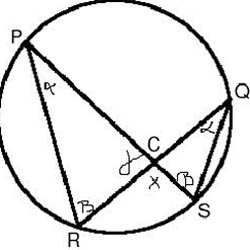
This is a very simple generalisation of the well known theorem
that the angle at the centre of a circle is twice the angle at
the circumference subtended on the same arc. First, as is usually
done, take C at the centre of the circle, fix the arc RS and take
P and Q to be any points on the circumference. Then the triangles
CPR and CQS must be congruent and isosceles because CP, CQ, CR
and CS are radii. Hence, the angles RPS and RQS are equal and the
angle at the centre RCS is equal to twice the angle at the
circumference.
To generalise this theorem to one about the angle RCS where C is
any point inside the circle, the triangles are no longer
isosceles, nor are they congruent to each other any more.
Aleksander Twarowski from Gdynia Bilingual High School No 3,
Poland proves that
angle RCS = angle RPC + angle CRP = angle SQC + angle CQS.
Angle RPS is equal to RQS, because thay lie
on the same arc.
Angle PRQ is equal to PSQ, because thay lie
on the same arc.
a+ b+ g = 180o
because they are angles of a triangle.
g+ x = 180o
because their arms PC and CS lie on a
straight line.
Hence, subtracting the last two equations
we obtain x = a+ b, which is
my generalisation of the theorem about the
angle at the centre of a circle being twice
the angle at the circumference subtended
on the same arc.