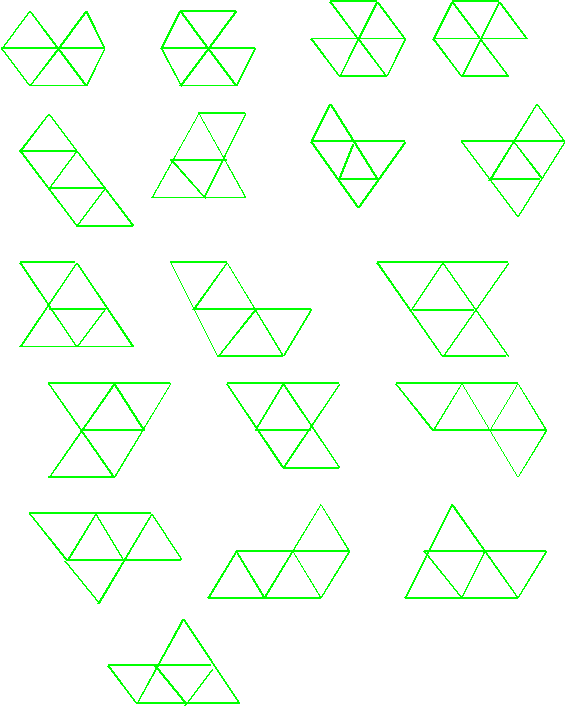
Finding the best solution for this problem depended on thinking
very carefully about what was meant by DIFFERENT ways of
arranging the five triangles. For example: Christine (Malborough
School) explained, "There is only one shape from the hexagon
group because when this shape is rotated it looks like different
shapes but it is just one basic shape".

As Sophie said: "There were 4 different shapes using all five
equilateral triangles, without rotating the shapes. The shapes I
made were: one was long and thin, but was not a perfect line
because it had 3 triangles on one side and 2 triangles on the top
side. The second shape had 4 triangles sloping upwards, and one
triangle on the side of it. The third shape was a big triangle
with a smaller triangle on the side of the top one. And the
fourth shape was shaped in the way of a croissant, and had three
triangles in a row, and two on top of the two end
triangles."
Leyla (Private IRMAK Primary School, Istanbul, Turkey) sent in
drawings of the four ways:

Merve (Private IRMAK Primary School, Istanbul, Turkey) agreed
with this set of four shapes too.
Caroline and Rebecca (The Mount School, York) also realised that
some shapes they found were really the same as others if you
turned them around or flipped them over. " We found six different
ones, but two of these are reflections in a way, so maybe it's
only four".
Kirstine (Tattingstone School) also saw how to group some
'variations' of the same shape together However, if you decided
to think about each position of the shape as being different,
then there would be many shapes in your solution.
Ece (Private Irmak Primary School) found 18 shapes. Do think
there are any more?
Christopher (Tattingstone School) found two more variations of
the straight line. Well done to everyone else who sent in some
shapes.