No one sent us a complete solution to this
problem, but here is the start of a solution which shows some good
mathematical thinking and a systematic way of working.
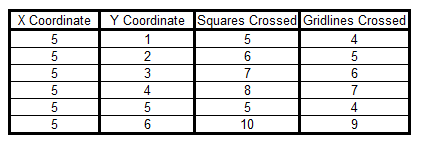
We decided to investigate what happens if you keep the $x$
coordinate the same and change the $y$ coordinate. Here is our
table to show the number of squares and gridlines crossed when the
$x$ coordinate is $5$.
We noticed a pattern for the number of squares crossed, which works
for every $y$ coordinate we tried except $5$. If you add together
the $x$ and $y$ coordinates and take away 1, you get the number of
squares crossed. This is because for example to get from (0,0) to
(5,3) you go along 5 squares and up 3 squares, meaning that you
travel through 8 squares altogether, but that counts the corner
square twice so you need to take away 1.
It doesn't work for (5,5) because you go diagonally through the
corners of the squares instead of cutting through the edges.
Can anybody build on this thinking and
explain the patterns found?