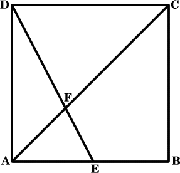
ABCD is a square and E is the midpoint of AB. Prove that FC = 2 AF and FD = 2 EF.
| Dear nrich, My name is Talei Lakeland and I am in Year 8 at Poltair Community School and Sports College in St Austell, Cornwall. My maths teacher is Mrs Hayes, and it is she who introduced your great puzzles to my class (8 set 1). Here is my solution for the puzzle 'Double Up', of the November Six. FD = 2EF and FC = 2AF because . . . We can prove that triangle FCD is an enlargement, by a scale factor of 2, of the triangle AEF. The triangles' angles are the same - at point F the crossing lines give each triangle an identical angle because they are opposite each other. The line AC joins parallel lines to give an identical angle to each triangle because they are alternate, and the line ED works in the same way. Therefore, because AE must be exactly half the length of CD, each line in triangle AEF will be half of its enlarged equivalent in triangle FCD. FD = 2EF because FD is the enlarged equivalent line of EF in
triangle AEF. Yours faithfully, |
Editors Note: Thank you Talei for this well explained solution. Another word used to describe a pair of triangles where one is an enlargement of the other is to say that the triangles are 'similar'.
Now what happens if ABCD is a parallelogram rather than a square? What happens if E is some other point on AB?