Congratulations to Ang Zhi Ping, age 15, River Valley High School, Singapore
for this solution.
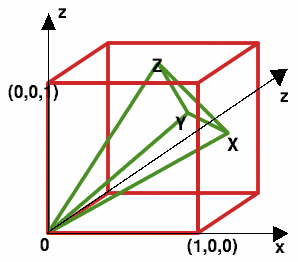
Take the vertex of the cube at the origin (0,0,0) as shown in the diagram.
The tetrahedron has vertices O,X,Y,Z, where the three centres
X, Y and Z are as follows:
X=
æ ç
è
1,
12
,
12
ö ÷
ø
, Y=
æ ç
è
12
,1,
12
ö ÷
ø
, Z=
æ ç
è
12
,
12
,1
ö ÷
ø
.
The area required is the sum of the areas of the triangles
XYZ (which is equilateral), and OXY, OYZ, OZX (which are
congruent to each other and isosceles).
Now