Meg offers this solution:
The tangent of a circle is at right-angles to the radius of the
circle. That is, if you join the centre point of the circle to a
point where the circle meets the outer triangle, it makes an
angle of
with the side of the triangle.
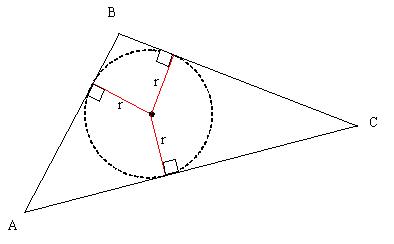
The bisector of the angles of triangle ABC will all pass through
the centre of the circle.
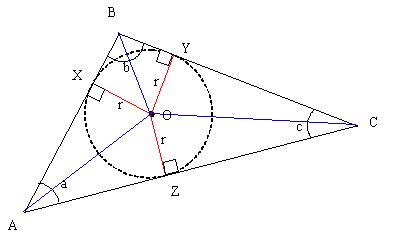
From this we know that
and
Hence
Now consider triangle XOZ. THis triangle is isosceles,
so
By similar arguments
and
Hence the new angles of the triangle are
Hence
It follows that
.
A similar argument can be followed for XYZ and YZX.
If you continue drawing triangles within circles, the angles will
decrease as shown here:
Triangle 1: a
triangle 2:
triangle 3:
=
triangle 4:
When you continue this iteration, you can demonstrate that the a
term becomes less and less significant, and the sum of the rest
of the terms tends to 60 degrees. Hence the triangle tends to an
equilateral triangle.