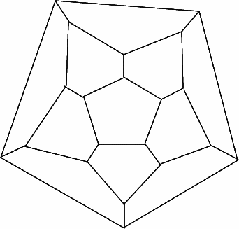
Here is a partial solution to this toughnut problem. As noted at the bottom although the path found has shown to be the most efficient given certain constraints, it hasn't been rigorously proven that it is the best in all cases. Can you do better?
As Glarynost walks around the planet, depending on where she is, she will be able to see:
Clearly being at a vertex is most beneficial in terms of seeing all the planet's surfaces. We will therefore assume for now (and hopefully demonstrate later) that the most efficient route will move only between vertices. However assuming Glarynost cannot tunnel through the planet (!) then moving from one vertex to the next will involve moving along a face (or edge of that face). This means at maximum two new faces will be visible upon moving to another vertex, as at least one of the three faces at the vertex must be the one that was just moved across (and so was visible at the previous vertex).
Assuming Glarynost's house is located at a vertex then she will start with three faces visible to her. If she then moves along faces to vertices where she can see two new faces each time, then in four 'moves' she will have seen another eight faces giving eleven seen in total. There is only one face she has now not seen, so if she now moves to a vertex where this will be visible from, she will have seen all twelve faces of the planet. As the final unseen face cannot have been one of the ones surrounding the vertex her house is at (as they were visible at the start), she must now need at least one more 'move' to return home.
If our initial assumptions were valid, then the journey just described gives a lower bound of six to the number of moves that it will take to see all of the planet's surfaces. If we can find a path that meets the description, it should therefore be the most efficient.
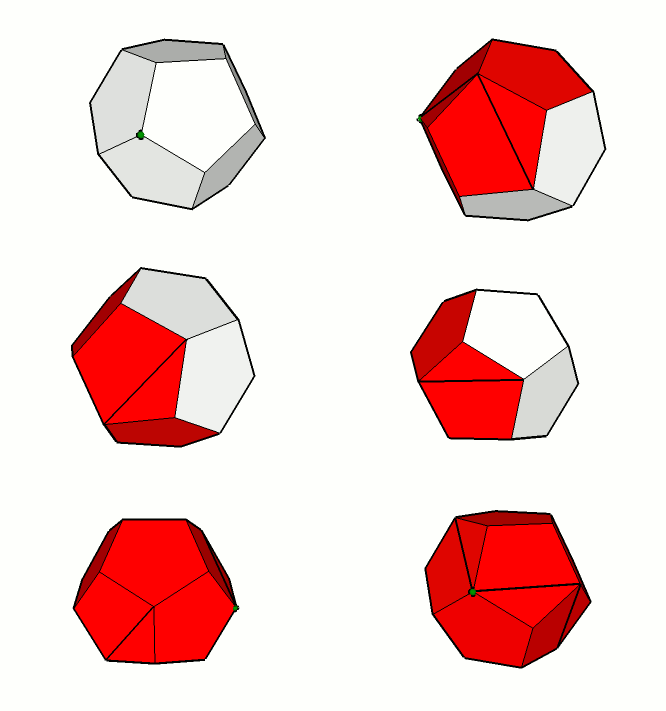
There are in fact a number of such paths, one of which is shown below. The green dot represents Glarynost's house with the faces shaded in red as they become visible to her during her journey.
Alternatively this (and other) potential paths can be represented numerically, using the diagram below as a key. Each vertex is specified by the numbers of the three faces surrounding it. For example $(1, 2, 3)$ indicates the vertex at the corners of faces 1, 2 and 3 of the dodecahedron formed when the net below is folded.
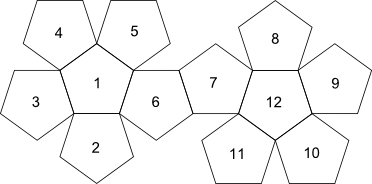
Using this notation one path that meets the requirements (the same as that shown in the animation above is):
$$(1, 2, 3) \overset{1}{\rightarrow} (2, 6, 11) \overset{2}{\rightarrow} (7, 11, 12) \overset{3}{\rightarrow} (9, 10, 12) \overset{4}{\rightarrow} (4, 8, 9) \overset{5}{\rightarrow} (1, 4, 5) \overset{6}{\rightarrow} (1, 2, 3)$$In order to show that such a path is indeed the shortest rather than simply having the smallest number of 'moves' / segments, we need to consider the lengths involved. Below are all the possible ways to cross one of the pentagonal faces of the planet starting from either a vertex or mid-point of an edge. To allow a comparison of the length's of these paths segments, the length of one edge has been assumed to be 1.
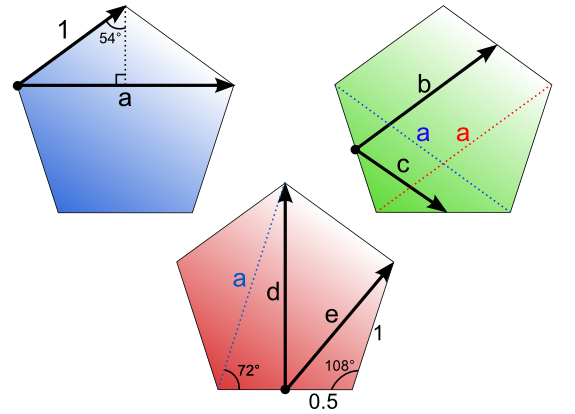
Defined as length 1
Length $a = 2 ( 1 \sin 54^\circ) = \frac{1+\sqrt{5}}{2} = 1.618$
Length $b = \frac{1}{2}(a+1) = \frac{3+\sqrt{5}}{4} = 1.309$
Length $c = \frac{1}{2}(a+0)= \frac{1+\sqrt{5}}{4} = 0.8090$
Length $d = a \sin 72^\circ = 1.539$
Length $e = \sqrt{1^2 + 0.5^2 - 2(1)(0.5) \cos 108^\circ} = 1.249$
The path defined above is composed of six vertex to opposite vertex segments and as such has a total length:
$$\ell = 6 \times 1.618 = 9.71$$Therefore if travelling along edges between vertices rather than across the faces, a path of 9 segments or less would be needed to be more efficient than the one above.
Using the same reasoning as above, three faces will be visible at first. Each subsequent move will reveal one more face (as the two faces which form the edge just moved along will be common to both vertices). So it will take nine moves to see all the faces of the planet. However again as above, it is impossible for the last of these moves to return Glarynost back home as she has already seen all of the faces surrounding her house, and so it must take more moves (in this case at least 2) to get back home. Such a path must therefore be longer than the first.
Moving edge-to-edge will always only reveal one more face each time, so will take a minimum of nine moves to see all the faces alone (plus moves to return home), and this in itself will make such a route composed of $b$ segments longer than our original one.
If we change our initial assumption that Glarynost's house is located at a vertex and instead assume it is located at the mid-point of an edge, we can follow a route composed of $c$ segments on which all faces will be visible and will return to the start point in twelve 'moves' (two faces visible at start, ten moves to see rest, two to return home). As the $c$ path segments are exactly half the length of the $a$ segments our original path was composed of, this gives a route exactly the same length as our original one. This shows it is not unique (which we actually knew already) thought it still is the most efficient found!
For the path types which alternate between edge mid-points and vertices ($d$ and $e$) using the same technique as above we can see it will take a minimum of seven moves to complete the journey: three faces are visible originally, each further two moves making a maximum of three more faces visible (vertex to mid-point one more face then mid-point to vertex two more faces) therefore requiring at least six moves to see all twelve faces. It will then again take at least one more move to return to home giving a total of seven moves. This straight away excludes a path composed purely of $d$ segments as $7 \times 1.539 > 9.71$.
The other option, using $e$ segments is a little less obvious. However it can be shown that in this case it will take at least two moves to return home once all faces have been seen giving a minimum of eight moves in total. As $8 \times 1.249 > 9.71$ this potential path is also excluded.
This at least in part indicates that the original path length of 9.71 seems to be the most efficient. However it is not a rigorous proof - for instances cases where different path segment types are mixed have not been considered. Can you think of a better way to demonstrate which path is most efficient (and perhaps even a better path)?