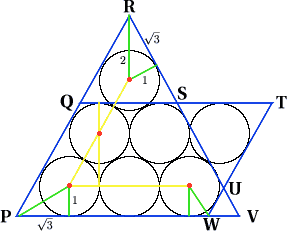
The triangle has side length $4+2\sqrt{3}$ so that area is ${1\over 2}(4+2\sqrt{3})^2 \sin 60^\circ$, or (equivalently, using half base times height) ${1\over 2}(4+2\sqrt{3})(3+2\sqrt{3})$, which is 24.12 square units to 2 decimal places.
Packing (B)
The base length is given by $PW=\tan 60^\circ +4+\tan 30^\circ = \sqrt{3}+ 4 + {1\over \sqrt{3}}= 6.3094.$ The height is given by $h = 2+2\cos 30^\circ = 2 + \sqrt{3}= 3.7321$, so that the area is 23.55 square units to 2 decimal places.
Packing (C)
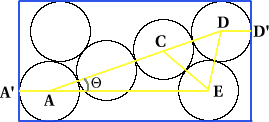
The line joining AE is parallel to the bottom of the rectangle. The base of the rectangle has length $AA' + AD \cos\theta + DD'$ which is $2+6 \cos \theta$. Similarly, the height of the rectangle is $2+6\sin\theta$. It remains to find $\theta$. As $\Delta CDE$ is equilateral, $\angle A C E = 120 ^\circ$. Using the Cosine Rule $\begin{eqnarray} AE^2&= 16 + 4 - 16\cos 120^\circ = 28 \end{eqnarray}$ so that $AE = 2\sqrt{7}$. Using the Sine Rule for $\Delta ACE$, $\begin{eqnarray}{\sin \theta\over CE} &= {\sin 120^\circ\over AE}, \end{eqnarray}$ hence $\sin \theta = \sqrt{3}/2\sqrt{7}$. Thus $\cos\theta = 5/2\sqrt{7}$, and the area is 30.40 square units to 2 decimal places.
Packing (D) : as the rectangle is $6\times 4$, the area is 24 square units.