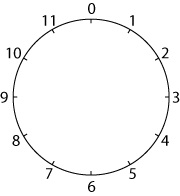
I started with a clock without hands or the minute divisions (except for those where there is a number). The 12 was replaced by a 0 and the numbers placed outside the face.
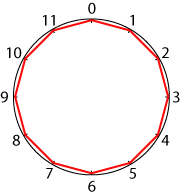
I ruled lines joining up the numbers.
I started by counting in ones and I got a 12-gon (that is a 12-sided polygon - if you like long words you can call it a dodecagon).
Then I ruled lines counting round in 2s. And I got .....?
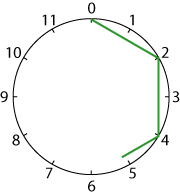
You do not need to put the numbers round the circles.
I tried 5s (wow!) and 6s (well!).
You go on drawing lines until you get to the point where you first started.
Then 7s, 8s, 9s, 10s, and 11s.
Something interesting was happening. What patterns do you notice emerging?
And what about counting round in 12s?
It was time to change the clock for a differently numbered circle.
What happens if you have a 10 dial, 8 dial or a 9 dial?
Or a 3-dial, 4, 5, 6, 7-dial or any other dial?
Can you predict what shapes you will get with different numbers? What are the rules?
Which numbers look the same but are drawn differently? What is the connection between these two numbers?
How can you make some really good stars? Here is another variation - a 10 dial star - for you to try or print.
[You'll need to have Flash installed to try it on the computer.]
Before you begin:
Write down the answers to a chosen multiplication table. As you
write down the answers, try to identify any pattern that
emerges.
Circle the last digit of each answer that you have written
down.
On the dial star below:
Click on the number of the multiplication table that you have
chosen.
Click again.
What is happening and why?
Keep clicking!
How does the result relate to the digits you have circled?
Try another number.