There were many replies to the puzzle of the bursting balloons. "I liked it when the balloon went bang!" was typical of the comment many of you wrote. I wonder if you kept trying this problem so that the balloon would pop. You needed to be very clear about what you were being asked in this problem. Here is some advise about how to make sure you are clear from Joey and Vincent, both 11 years old from Colindale Primary School in London:
"We read the passage again and again until we understood the problem"
We know that at the beginning of Katie's seventh blow the balloon popped. The question was how many puffs did it take Will to burst the balloon. Some people told us how many puffs of air he blew in before it burst and others said which was the puff of air that was just too much for the balloon to take.
Several different answers were submitted. Was this the type of problem that has a single answer or do you think there could have been several solutions?
Different strategies and approaches were taken. Some people used their knowledge of addition, others used multiples and another group of problem solvers used their understanding of fractions to arrive at their solutions.
Allison Marriot explains a strategy using first a fraction and after that using addition.
To find out what was happening with Katie, we did this
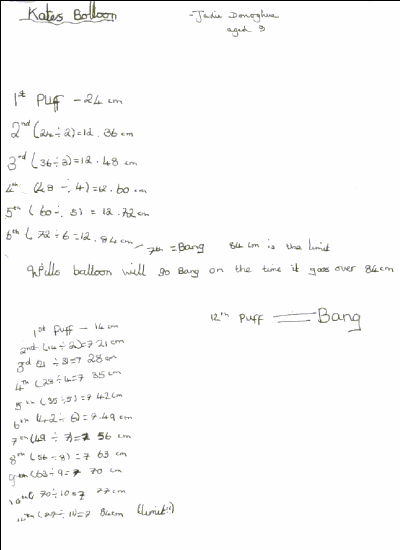
24 + 12 = 36
36 + 12 = 48
48 + 12 = 60..
And so on.... 24, 36, 48, 60, 72, 84 then Bang!
For Will
Half of 14 is 7.
You use this information and add.
So, 14 + 7 = 21.
As Crewe, Errington, Porter and
Croft explain: "Then keep adding 7 to your number
until you get 84".
Count how many times you added on 7 and you have the answer
So .. 14, 21, 28, 35, 42, 49, 56, 63, 70, 77, 84 then Bang!
Jadie Donoghue, from Tattingstone School, shows how division was the operation that helped her find and answer.
Joey and Vincent made use of
what they know about fractions to find a solution:
Katie's first puff of the balloon measured a circumference of 24cm
.then 1/2 as much had to be added onto 24cm. We found that half of
24cm was 12cm and we added it to 24cm. That came to a total of 36cm
.we found 1/3 of 36cm and got an answer of 12cm and added it to
36cm. That gave us a total of 48cm.we found a 1/4 of that and we
did the same thing for 1/5, 1/6.
See the pattern beginning to unfold?
Verity Bramwell, aged 8, explains her answer by finding a common multiple of 12 and 7:
I worked it out by working out the size of Katie's balloon as
she blew it up. The numbers went up in the 12 times table. With
Will's balloon, the numbers went up in the 7 times table. I wrote
out my 7 times table until I found a number that was the same as in
Katie's list.
My lists looked like this:
| 24 | 14 |
| 36 | 21 |
| 48 | 28 |
| 60 | 35 |
| 72 | 42 |
| 84 | 49 |
| 7th blow | 56 |
| 63 | |
| 70 | |
| 77 | |
| 84 | |
| 12th blow |
(the tornado) as well as Emily Carlyle, Emily Gibbons, Gabrielle Grey and Rebecca Sherwood, from Year 7 at The Mount School think Will did 11 puffs before his balloon burst. Or, as Verity puts it, what burst the balloon was the 12th blow!