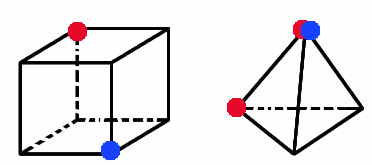
To solve this tough nut, start by colouring one vertex red. In the cube there are different paths from the red to the blue vertex along the edges but all these paths have an odd number of edges so this is a blue vertex and not a redblue one. By contrast the vertex at the top of the tetrahedron is redblue because it can be reached by going along one edge (an odd number) and also by going along two edges (an even number).
Simon and Nick sent in their results from looking at several other solids:
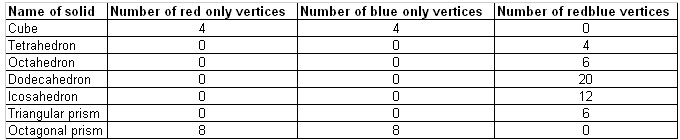
"This shows that all shapes either have no redblue corners, or they are all redblue. This is because if one of them is redblue then all the ones next to it must be redblue too because they can't just be red or blue. Alternate corners have to be red, then blue, then red etc. If one vertex is redblue, then all the ones next to it are both an odd number and an even number away from a red one, so they are redblue too. That means they all must be, because all the corners are connected to each other".
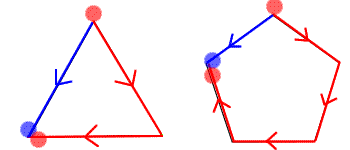
Unfortunately no-one has been able to spot the key feature which determines whether a shape has all redblue, or no redblue vertices. It is easier to explain if we look at the shape of the faces of some of these solids. All of the ones with redblue vertices have at least some faces that have an odd number of sides, i.e. triangles, pentagons etc. This means that if you just look at one face, you can reach any vertex by two different paths, say clockwise or anticlockwise. One of these will always be odd, and the other will always be even, because they have to add up to an odd number of sides altogether.