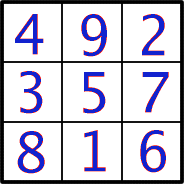
This investigation gives plenty to do for pupils of widely differing abilities.
If pupils have not encountered a Magic Square before, the traditional 3 x 3 one might make a good start.
If there is a problem in identifying the 2 x 2 little squares within the 4 x 4 square the first one in the bottom left hand corner could be selected.
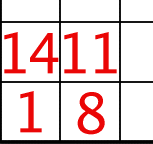
After the initial search for four numbers that add to the Magic Constant in the initial given Magic Square investigation changes direction.
The suggestion to find the Magic Constant if 2 is added to each number, and if the numbers are doubled, should give hints enough for pupils to explore ways of making different Magic Constants.
Pupils should write down the function used to make each one then, if different ways are found, the most simple one could be chosen. Thus the idea of an 'elegant' method could be discussed.
The given 4 x 4 Magic Square can be further explored. If, for example, the left hand column is moved entirely to right hand side, the square is still 'Magic'.
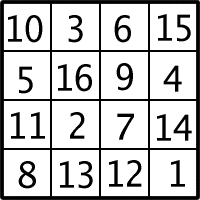
Similar changes as this can be explored and lists of more ways to make the Magic Constant made. Do these cover all the ways of making it from four numbers from 1 to 16?
What would the Magic Constant be for a 1 - 25 (5 x 5) Magic Square?
Or a 1 - 36 (6 x 6) one?