Congratulations to Tony from State College Area High School,
Pennsylvania, USA for this solution.
First of all, here is the solution to finding the equation of
the orthogonal circle for the circles with centers of (0,0),
(3,0), (9,2) and radii respectively of 5, 4, and 6.
As the circles are orthogonal we can draw three right angled
triangles. One of the legs of each right triangle is the radius
of one of the given circles, the other leg is the radius of the
unknown orthogonal circle, and the hypotenuse is the distance
between the center of the known circle and the center of the
unknown orthogonal circle.
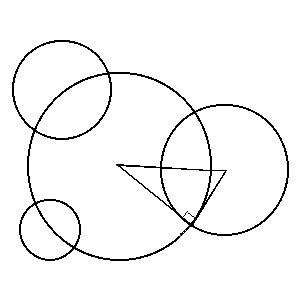
Since we have three given circles, we can use the Pythagorean
Theorem three times to find our answer. Here are the
equations that find the center (h,k) of the orthogonal circle with radius r:
|
|
Now subtract equation (B) from equation (A) to get
,
so
. Now plug
in equation (A) to get
Next plug
and
into
equation (C) to get :
|
|
from which we find
Plug
in equation (A) to get
So now we have
all we need to make the equation of the orthogonal circle:
,
and
, so the equation of the orthogonal circle
is
When we try to find the orthogonal circle for the second
example, we end up with simultaneous equations which are
fruitless, unsolvable. This means the second equation has
an orthogonal line, in this case a fairly obviously one with
Now I will prove that you have an orthogonal line when the
centers of the circles are collinear, otherwise you have an
orthogonal circle.
Any orthogonal line would have to form a right angle with
every given circle. When a line forms a right angle with
the circumference of the circle, that means it passes
through the center of the circle, so our orthogonal line
passes through the centers of all the circles. The only way
this is possible for our line to accomplish this (since two
points determine a line, three points determine a plane), is
if all three centers are collinear.
Therefore, lines can handle every case of collinear centers,
and since an orthogonal line or circle can always be drawn,
every other case is covered by an orthogonal circle.
[We have used Tony's American spelling of center here. Ed.]