Thank you Andrew Clark for this solution.
(a) It is known that the area of the largest equilateral
triangular section of a cube is 140cm 2 . What is the
side length of the cube?
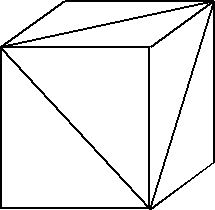
Let the sides of the equilateral triangle have length
; then
the area of the triangle is
.
As the area of the triangle is
,
.
The length of the diagonal of a face of the cube is
; let
be
the length of a side of the cube. Then, by Pythagoras' Theorem,
so that
to three significant figures.
(b) The distances between the centres of two adjacent faces of another
cube is 8cms. What is the side length of this cube?
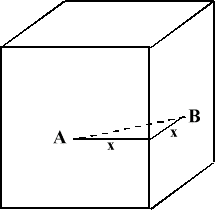
Let the side length of the cube be
.
From the centre points A and B of both faces to the line at
which their planes meet is
, and AB (
) is the hypotenuse of
a right angled triangle whose other two sides have length
.
Therefore
, so that
,
and the length of the side is
.
(c) Another cube has an edge length of 12 cms. At each vertex a
tetrahedron with three mutually perpendicular edges of length 4 cms
is sliced away. What is the surface area and volume of the remaining solid?
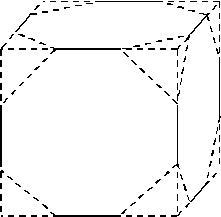
From each face of the cube we remove four triangles whose total area is
. Thus the area left is
. There are six such faces giving an area of
.
In addition, there are eight equilateral triangular faces of side length
. The total area of these is
. Thus the total surface area is
to the nearest square centimetre.
The volume of a tetrahedron is
.
Consider one of the tetrahedra, and take one of the right-angled
triangles as its base; then its volume is
.
Thus the volume of the remaining solid is
to the nearest cubic centimetre.