We had several well-explained solutions to
this problem. Well done!
Yajur and Johar from the London Academy
wrote:
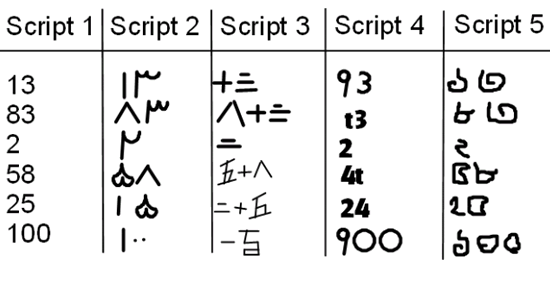
We knew that / .. was $100$ in Arabic, so that gave us the idea
to find the $100$ in each script first. Once you have $100$,
you have the $1$ which you can use as follows:
The number $1$ is the first number visible in $100$ and
$13$.
The number $3$ is last number visible in $13$ and $83$.
When you know $83$, you can see the $8$, so find $58$.
When you know $58$, you can see the $5$, so find $25$.
$25$ gives you the $2$.
You can do the same thing in reverse, e.g. find $2$ first and
find $0$ last.
Here is the image of their solution they
sent:
Hannah, Lily, Emma, Sarah, Fergus,
Nathan and Aleish from Rutherglen Primary told us about how
they tackled the problem. I like their approach of cutting the
numbers out. They said:
We knew we needed five scripts and six numbers of each
We cut out the numbers
We drew columns to stick them in
We laid out the English and Japanese numbers in their columns
(we learn Japanese at our school so this step was easy)
From there, they were able to solve
the problem in a very similar way to Yajur and
Johar.
Gabriella from St Margaret's College
told us how she found a solution:
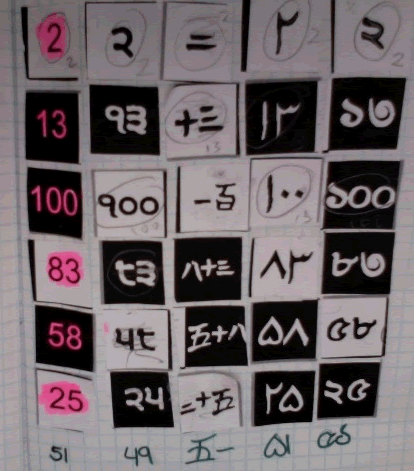
What I did was to organise them into our language script first.
The numbers are $2$, $13$, $100$, $83$, $58$, $25$.
Then I looked for patterns and similarities such as curves,
dots or strikes. In the picture below all the horizontals are
the numbers and all the verticals are the scripts.
The hardest one I found was the Chinese, as + was $1$ or $10$
in the number $13$, but in all the others it was a
multiplication such as =+ is two tens. The most important thing
to do is keep track of your work, so what I did was stick all
the ones I had done in my book as I went along. Once you get
going it is actually quite simple.
Thank you, Gabriella. I like the way
you're thinking about how the Chinese script works. (The
Japanese and Chinese number systems are essentially the same,
but are pronounced in different ways.) Gwendolyn from Sha Tin
College in Hong Kong explains her approach and she sheds some
light on the Chinese system:
The first thing I did was to separate the numbers into groups
according to the language they are written in. I call the
different languages A, B, C etc.
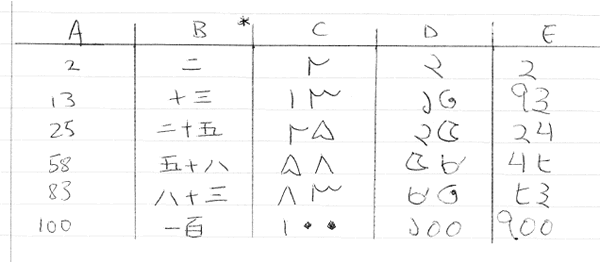
Now, language A is the number system we usually use, and
language B is Chinese, which I also know, so this is $51$
written in these languages:
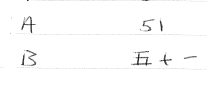
In Chinese, usually two-digit numbers have three characters
because the number in the middle is ten. For example, in the
number for $25$ (see the table above), the two horizontal lines
equal $2$, the cross is $10$ and the final symbol is $5$.
Basically, it's $2/times10 + 5$.
But before we move on, this is how I grouped the numbers
together, e.g. with language C:

It's the same with all the different languages.
So, how did I work it out? This is how I did it:
First I noticed that in every single language, $2$ is
represented by only one symbol.
Once I knew that, I worked out $25$.
Then $58$, $83$, $13$ and $100$.
Gwendolyn says she was curious about
the other languages and went on the internet to find out about
them. She reports that C is Persian, D is Bengali and E is
Gurmukhi. What do others think? Did anyone else find out what
they are?