This question is about gnomons, not gnomes, the tiny magical people, but very remarkable mathematical L shapes. A gnomon is the shape of a carpenter's tool still used today which appeared often in Babylonian and Greek mathematics. A gnomon is a rectangle with a rectangle cut out of one corner. To do this question you may like to use squared paper, pencils and scissors.
The rule for the Fibonacci sequence is that, starting with 0 and 1, each term is the sum of the two terms before it. The Fibonacci sequence is:
0, 1, 1, 2, 3, 5, 8, 13, 21, 34, ...
Each Fibonacci number has its gnomon with the area of the gnomon equal to the number. Here are the gnomons for 3, 5, 8 and 13.
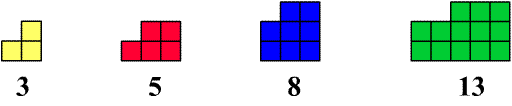
Draw them for yourself on squared paper, cut them out and fit
them together like pieces of a jigsaw to show that
3 + 5 = 8, 5 + 8 = 13, etc. obeying the Fibonacci rule. Now, to
give the solution for this question, draw the gnomons for 89 and
144 and show how each one is made up of two gnomons according to
the Fibonacci rule.
Now look at the shapes of the gnomons for the alternate Fibonacci numbers (every other number in the sequence rather than every consecutive number). What do you notice about the gnomons for 3, 8 and 21 etc. that is different from he gnomons for 5, 13 and 34 etc?
[This question is inspired by a paper in the journal The Fibonacci Quarterly (1981, pages 35-39) by D.W. DeTemple.]