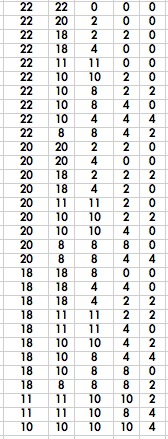
Timmy, Mo and Meg sent us their work on this problem: We
started with the largest number, 22, and added numbers as small
or smaller than it to get 44. We were sure we hadn't counted
anything twice because we always added smaller than or equal to
the last number we'd added in each sum, and we always started
each new sum with the second number smaller than or equal to
the second number of the sum before it. We got ten sums:
22 + 22 + 0 + 0 + 0
22 + 20 + 2 + 0 + 0
22 + 18 + 4 + 0 + 0
22 + 18 + 2 + 2 + 0
22 + 11 + 11 + 0 + 0
22 + 10 + 8 + 4 + 0
22 + 10 + 8 + 2 + 2
22 + 10 + 4 + 4 + 4
22 + 8 + 8 + 8 + 0
22 + 8 + 8+ 4 + 4
We noticed that if we had a 4 + 0 we could get another answer
by swapping that for a 2 + 2, and if we had a 8 + 0 we could
get another answer by swapping that for a 4 + 4. We also
noticed that if we added an 11 we had to add another 11 to make
the total even.
Then we did the same starting with 20 and adding the numbers
smaller than or equal to 20, so we wouldn't count any of the 22
sums twice. There were 11 sums. Then we did the same starting
with 18. There were 9 sums. Starting with 11 there were only 3
sums. Starting with 10 there were 2 sums and there were no sums
starting with 8 or smaller, because 8 + 8 + 8 + 8 + 8 = 40 is
too small.
That made 35 different ways of making 44 on a dart board.
Thank you very much, Timmy, Mo and Meg! Great work!
Here are the canonical results:-