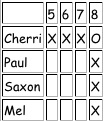
Carl sent in his solution. He filled in the table by putting a X
if he knew it definitely wasn't the answer, and an O if he knew
it definitely was. Cherri is the oldest, so she must be 8. So we
can fill in the table like this (because she can't be any other
age, and nobody else can be 8).
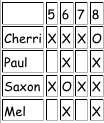
Since Saxon's age is an even number, he must be 6, so we can fill
in the table like this.
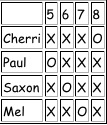
Now Mel's age is half of Cherri and Saxon's ages added together,
so Mel's age is half of 8+6=14, so Mel is 7 and Paul is 5. If we
wanted to, we could fill in the table to show the answer:
OLD NOTES
This problem can be read like a story and a series of questions
asked of the children. These might focus on recall of the
information, inferences, guess, estimations etc.
For example:
Who is the eldest friend?
What are the possible ages Saxon could be if his age is and even
number?
What is the age difference between the oldest and youngest
friend?
Who do you think might be the youngest? Why?
How old is Mel if she is half of the combined ages of Cherri and
Saxon?
Before the matrix is introduced as an organising tool, it is
valuable to allow the children to create their own method of
keeping track of the information. This allows for a critical
discussion of effective and efficient ways of sifting
clues.