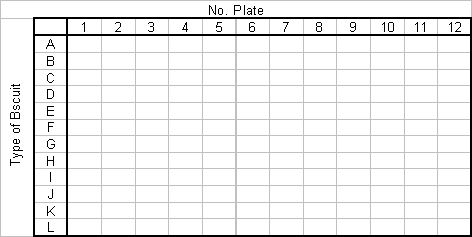
In this problem you knew how many plates of biscuits you would finish with. You weren't to add or eat any, so you had to still have 12 plates. The question was, what biscuits would be on the 12 plates. A very important part of the strategy here was to find a way to show the results and to keep track of the biscuits you have used. I have changed how most of the solutions looked. Many of them were sent in as a long list of letters. I have tried to set them out so that the solutions can be seen more easily. This is an important thing for you to do as it helps you check that you have included all possibilities and don't have repeats. One way of doing this came from Ms Brown's class, at Alice Smith International School, in Kuala Lumpur, Malaysia, at the end of these solutions. It was a very clearly set out table created using a spreadsheet. If you don't know how to set up a spreadsheet, check with your teacher.
Emma and Abi of Moorfield Junior School found the following combinations of three biscuits from the 12 different varieties, this was the same as that sent in by Sarah and Helen from Glenmead Primary in Birmingham. They show their answers as a list, but first they explain the strategy they used to help them with so many possibilities:
First, we started with alphabetically, ABC, DEF, GHI and JKL.
Then we did the first letter of the first three biscuits (ADJ).
Next we took the second letters (BEH) of each plate of biscuits.
Finally, we sorted out the ones left over.
The possible plates of biscuit varieties that the girls came up with were:
| HIG | HKJ | ABC | DEF |
| ADJ | EBH | AIK | FIC |
| KLA | DBG | LEC | FLG |
Prateeksha, from Riccarton Primary School, shows a slightly different strategy. It is a list like Emma and Abi's but can you see how the information has been organised in this list? The organisation is what shows Prateeksha's thinking.
| Plate A contains biscuits A, H, L |
| Plate B contains biscuits B, H, K |
| Plate C contains biscuits C, B, A |
| Plate D contains biscuits D, A, J |
| Plate E contains biscuits E, B, D |
| Plate F contains biscuits F, E, C |
| Plate G contains biscuits G, J, K |
| Plate H contains biscuits H, G, E |
| Plate I contains biscuits I, D, C |
| Plate J contains biscuits J, L, I |
| Plate K contains biscuits K, I, F |
| Plate L contains biscuits L, G, F |
Is this list the same as Terry and Daren's from Alma Primary School in London?
| plate 1. AKL |
| plate 2. BDK |
| plate 3. FIJ |
| plate 4. DGI |
| plate 5. BEH |
| plate 6. FGL |
| plate 7. BGJ |
| plate 8. AHI |
| plate 9. CEJ |
| plate 10. ACF |
| plate 11. CHK |
| plate 12. DEL |
Helen and Joanna from W.C.P.School in Manchester sent in a list of their 'plates' and used letters to represent the biscuit varieties, as did James from Girton Glebe Primary School near Cambridge. Although the order of their answers was different, the combinations were the same.
Hannah, Amy, Jenny and
Emma, also from Moorfields School, seem to have a completely different way of figuring out their solution. But have they?
Can you see what they have done?
But how do you keep track of all that information? This is what Alex from Brecknock School did:
I started with abc, then def, ghi, jkl and then mixed them up.
I made a list of all the biscuits as they were used, after that I crossed out a letter every time I used one of that type.
| a | d | g | j | l | c | l | f | b | j | k | b |
| b | e | h | k | h | e | h | i | k | c | a | f |
| c | f | i | l | d | g | a | j | i | d | e | g |
Hmm, it looks like 'a and f' in the centre line are not matched with other biscuits. Why do you think that is?
Oskar, a fellow pupil from Brecknock Primary, started with A(lmond finger) and I moved 1 A forward 1 place and another A forward 2 places. I did the same with the next plate then the next plate and so on. The solution ended up like this:
| 1 | 2 | 3 | 4 | 5 | 6 | 7 | 8 | 9 | 10 | 11 | 12 |
| k | l | a | b | c | d | e | f | g | h | i | j |
| l | a | b | c | d | e | f | g | h | i | j | k |
| a | b | d | e | f | g | h | i | j | k | l |
Wait a minute, does the last plate only have 2 biscuits? Should they all be full?
Nathan, also from Brecknock explains; first I wrote
a table.
I started with kbc then I made sure that I used each biscuit once
I continued with the rest of the biscuits. When I had used all the biscuits I had to mix the biscuits about. This was my answer:
kbc, def, ahf, jk, dbe, bgc, jhb, fki, aij, iel, lgd, gca.
The students of Ms Brown's class also organized their information in a table, but in different way then Oskar. Did they arrive at a different answer the other pupils above?
They begin by explaining their notation. They used a combination of letters (for the variety of biscuit) and numbers (to show if it was the first, second or third biscuit selected).
Notation:
Almond Fingers = A1 (biscuit 1), A2 (biscuit 2), A3 (Biscuit 3).
Bourbon = B1, B2, B3.
Chocolate Chip = C1, C2, C3.
Digestive = D1, D2, D3.
Easter Biscuits = E1, E2, E3.
Fig Rolls = F1, F2, F3.
Gingernuts = G1, G2, G3.
Honeynut cookies = H1, H2, H3.
Iced Wafers = I1, I2, I3.
Jammy Dodgers = J1, J2, J3.
Kiwi Cookies = K1, K2, K3.
Lemon puffs = L1, L2, L3.
Working it out:
Altogether there are 36 Biscuits.
12 types of biscuits and 12 plates.
So, what did they do with the information? They used a spreadsheet and built a table like this. One of the pupils explains:
Put A-B-C together, D-E-F together, G-H-I together and J-K-L together:
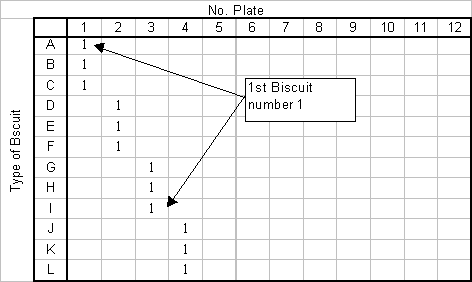
Now there are 2 of each biscuit left.
Then trying and modifying something, I got this:
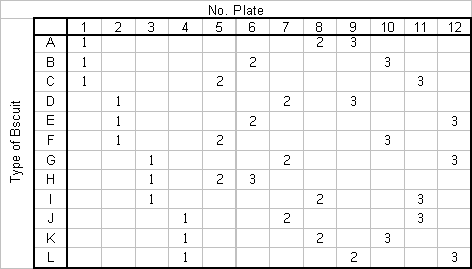
Now, what do all of those numbers represent and what do you need to do next?
Can you work the meaning of the numbers on the table?