The solution below was done by Arun Iyer, age 17, S.I.A Junior College, South Indian Assoiate, Nr Station Dombivli (W), Thane Di 421 202, India and similar solutions were sent in by Tony Cardell and John Lesieutre, age 14, from State College Area High School, Pennsylvania, USA.
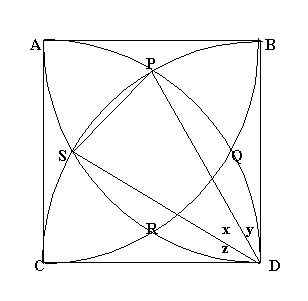
Given a square ABCD of sides 10 cm, and using the corners as centres, construct four quadrants with radius 10 cm each inside the square. The arcs intersect at P, Q, R and S and we have to find the area PQRS enclosed by the arcs.
Consider triangle CPD and SBD. Both are equilateral triangles.
(CP = PD = CD = 10cm and SB = SD = BD = 10cm). Therefore from the
diagram
. We know that
so from these three equations,
.The area of segment PS = area of sector PDS - area of triangle
PDS. Call this area
By symmetry, there are 4 such equal segments. Hence, the total area of the segments is
Since the angles subtended by the arcs PQ, QR, RS and PS are equal, we get chords L(PQ) = L(QR) = L(RS) = L(PR).
We can find L(PS) by applying the cosine rule to triangle PDS,
The required area of PQRS = area of 4 segments + area of square
PQRS.