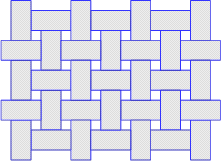
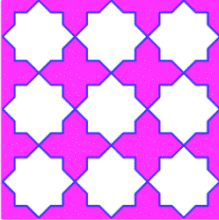
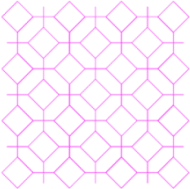
The art of tiling has been around since the beginning of early civilisation. This is evident in the floors and walls of ancient monuments and other religious buildings.
Alhambra at Granada in Spain is famous for some of the finest Moorish Art and you can see there examples of all the mathematically different tiling patterns that can be produced. The mathematical classification of such patterns is important in crystallography and you can find some examples in LOGOland from March 2001 and April 2001 .
Below are some floor tilings seen in Victorian houses here in Cambridge! What better way is there to use the power of LOGO than to reproduce and systematically study some of these remarkable artefacts? Can you devise elegant programs to replicate them?
Beginners can start with FIRST FORWARD 1 here or go back and follow through the series month by month starting from the Introduction to LOGO in July 1999 .
Repeat REPEAT
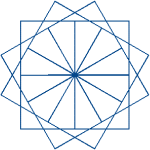
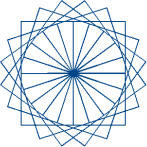
Now that you have seen how easy it is to draw squares triangles, pentagons, hexagon, heptagons etc. let us use these shapes as basic units of a pattern. Why not repeat what you have already repeated!
Imagine:
| Drawing a square | (Say, REPEAT 4 [FD 50 RT 90]) |
| Now turn 30° left. | |
| Draw another square. | |
| Now turn another 30°. | |
| Draw another square. | |
| Now turn another 30°. | |
| Draw another square. | |
| Now turn another 30° | |
| and so on until you get back to where you started. |
Now this is really: REPEAT 12 [REPEAT 4 [ FD 50 RT 90] LT 30] (hint: 12 x 30 is 360)
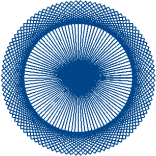
Why not experiment with other turns, other sizes, other shapes.....other...?
 |
 |
 |