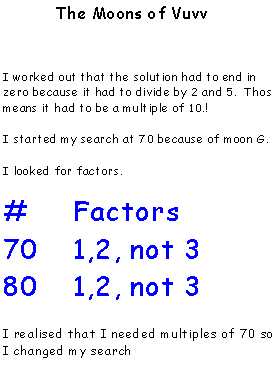
Now, I wonder what Becky changed her search to? If Becky is going to change her search to try and arrive at an answer perhaps she wants to think about this idea.
Alex and her family from Leicester, England worked on this Vuvvian problem. Alex explains how they set about arriving at a solution:
Now although 210 years is a long time, Anita and Jing Jing from Kilvington Girls' Grammar in Australia, think that's only the half of it...in fact, they think that it is 420 year wait between Super-eclipses. But Thomas, from Suffolk, thinks it's way longer than that - twice as long.
He wrote: "There are 840 Vuvvianyears between the Super Eclipses. I worked it out by going through the 7 times table and writing it down seeing that this would be the hardest to divide by. I then realised that the number had to end in a zero because it had to be divisible by 5 and 2. That meant that all I had to do was find out if the multiples of 7 were divisible by 3, 4 and 6 and if they were multiply them by 10. In the end 84 was the lowest number divisible by 3, 4 and 6 so I multiplied it by 10 and got 840."
Franco and Jonny from Northamptonshire agree that is it 420. They say:
We started off with 42. Every number goes into 42, except 5, so we multiplied it by 5.
6 doesn't go into 210, so we went back to 42. We then multiplied 42 by 10, to get 420. We checked by dividing 420 by 1, 2, 3, 4, 5, 6 and 7. They are all factors of 420. So the overall answer is 420.
So, who is correct?