Joseph's solution involved trial and
improvement:
First I decided that the number of pupils in the class had to be
a mulitple of 10 so that I could work out the percentages with no
fractions of people.
I started with 20 pupils in the class. This meant that 14 passed
one question (70%) and 12 the other (60%). As 9 pupils passed
both questions this meant that 5 got only the first one right
(14-9) and 3 the second one, making a total of 9 + 5 + 3 = 17
pupils. This is not enough as I started my working with 20
pupils.
Next I tried 30 pupils in the class. This time 21 passed one
question (70% of 30) and 18 passed the other question (60%).
Taking out the 9 pupils who passed both gave:
21-9 = 12 passing one question,
18-9 = 9 passing the other
9 passing both.
This makes a total of 30 (12+9+9), which is right
There were 30 pupils in the class.
***
This is Zi Heng's solution:
| 70% + 60% |
= 130% |
| 130% - 100% |
= 30% |
|
|
| 30% |
= 9 pupils |
| 100% |
= 9/30 * 100 |
|
= 30 pupils. |
30 pupils took the exam.
Andrei, School 205, Bucharest, Romania
solved this problem using a Venn diagram.
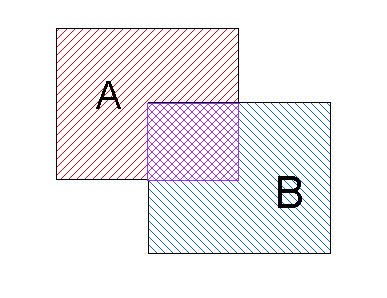
Let A be the set of solvers of the first problem, and B the set of solvers of
the second problem and the number in set A be written
n(A) etc. Their
intersection has 9 elements:
Their union contains all students. It is evident that:
If x is the number of students participating in the exam, then A has 70 per
cent of x elements, B has 60 per cent of x elements, and relation (2) can be
re-written as
or x=30. So, 30 pupils
came to the exam, 21 solved the first problem and 18 the second one.
Prateek , James , Alan , Jenny and Robert
also sent in good solutions. Joseph's solution to the second part
of the problem stated:
As all the pupils solved at least one problem 44% solved both
and this is 11/25 in its lowest form.
72% - 44% = 28% = 7/25
This means that the number of pupils in the group must be a
multiple of 25.
So, if 25 pupils took the exam14 solved one problem (7+7) and
11 both.
If 50 pupils took the exam 28 solved one problem and 22 both
and so on...