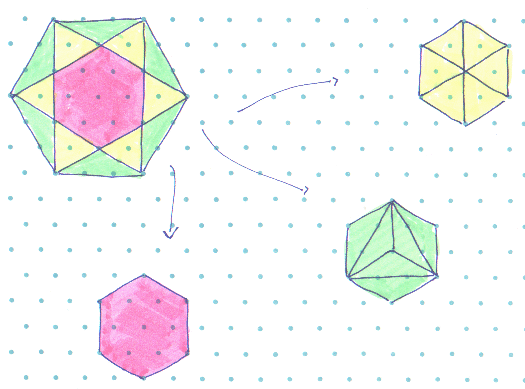
Malcolm Findlay from Madras College in St Andrews, Scotland has solved the first part of this problem:
Izumi Tomioka, Carol Chow and Priscilla Luk from The Mount School in York solved the second part of the problem:
The original hexagon has sides of length 3 units and we need to work out x, the lengths of the sides of the smaller hexagons.
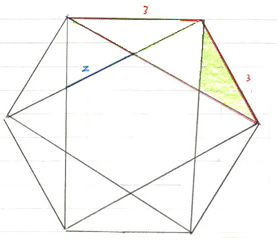
The hexagon below has been made from 6 of the shaded triangles
above.
We need to find the length of one of the sides of this hexagon.
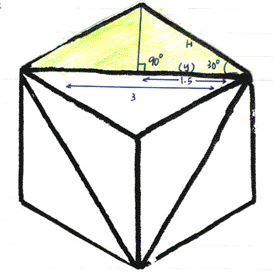
Splitting the shaded triangle into half gives us a right angled triangle such that:
Andrei Lazanu (aged 12) from School 205 in Bucharest, Romania, solved both parts of the problem.
This is how he tackled the second part:
To calculate the lengths of the sides of the smaller hexagons I used the following notations:
l for the length of side of the great hexagon
a for the length of side of the small hexagon
I used the following notation:
Triangle ACE is equilateral, because its sides are
congruent.
So, angle EAC is 60°.
Angle FAB is 120°, since each angle of a regular hexagon is 120°.
Triangle AEF is congruent with triangle ACB, having all sides
congruent. They are also isosceles triangles.
This means that each of the angles FAE and CAB is 30°.
Therefore angle EAB is 90°.
Triangle AMN is also equilateral, because it has a 60°
angle (MAN) and AM = AN.
Triangle ANB is isosceles, so AN and NB are congruent.
Therefore, in the right angled triangle MAB,
MA = MN = NB = a
AB has length l
Applying the Pythagorean Theorem:
l 2 = (a + a) 2 - a 2
l 2 = 4a 2 - a 2
l 2 = 3a 2
l = a √3
If the length of the side of the great hexagon is 3 units
long
l = 3
Therefore
a =√3 units
An alternative way of calculating "a" takes into account the
first part of the problem:
the area of the great hexagon is three times the area of the small
one.
For a hexagon of side l, the area is calculated as 6 times the
area of an equilateral triangle of side l,
this means that the area of the great hexagon is:
| (1) |
The 3 smaller hexagons of side "a" have a total area of:
| (2) |
Since, (1) and (2) represent the same area,
3a 2 = l 2
which is the same as we found above.