There are a few points worth thinking about when you tackle a problem like this:
Jacqui Eaves made a good attempt at this problem and Andrei Lazanu's work forms the basis of the solution below, well done Andrei.
The solution
First I calculated the angle between two sides of the
pentagon.
I used the formula for the sum of angles of a regular polygon,
with n sides, that is:
180°(n-2)
For the pentagon, I obtained:
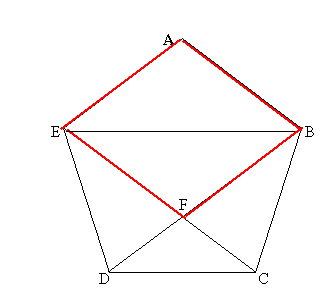
Triangles CDE, DCB and AEB are isosceles (sides of pentagon are one unit)
Then I calculated other sets of equal angles:
Here are all the measures of the angles that I obtained:
| Angles | Measures | |
|
|
108° | |
|
|
36° | |
|
|
108° | |
|
|
72° | |
|
|
72° | |
|
|
36° |
The four sided polygon AEFB is a rhombus because it has all sides equal (one unit)
Triangles EFB and DFC are both isosceles, their corresponding angles are equal
I used the following notation:
Using the relationship obtained using the similarity of the
triangles, I obtain:
I know that r = x + 1 because triangle BED is also
isosceles.
x and r are the solutions of the following system of two
equations:
I calculate the two numbers, x and r , substituting r from the
second equation into the first. I obtain an equation of the form:ax
2 + bx + c = 0
Which has the solutions:
Solving the equation obtained for x, I obtain successively:
The last solution is not a solution for the problem, because x cannot be negative, but the first one is. So I proved that
Now I calculate r, that is x + 1.
In conclusion: