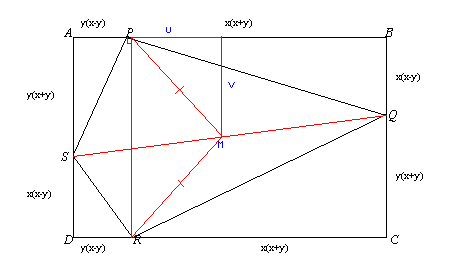
Richard sent us his work on this
problem.
-
We can say that
and
are similar triangles (ratio of
sides same),
so in terms of angles:
(angles in triangle add to
)
(angles from
a point
on a straight line add to
)
.
-
Same applies again here, triangle
is similar to
, and
so in terms
of angles:
.
-
As two opposite angles add up to
, the other two must as
well
(angles in quadrilateral add up to
). Two pairs of opposite
angles each adding to
implies a cyclic quadrilateral (one
of
the Circle Theorems).
-
Firstly, as
and
are both
,
line
must be the diameter of
the circle with midpoint being
centre of circle,
.
As
is a rectangle,
and
are
both right
angles. Also lines
, as
and
are on the circle.
Midpoint
is also the centre of the rectangle. Let
be the length
of the perpendicular from
to side
, and let
be the length
from the foot of this perpendicular to
, as shown in the diagram.
As
,
(isosceles triangle)
(angle at centre is double that
at edge - Circle
Theorem)
-
As
(Cyclic Quadrilateral)
.