Why do this
problem?
This problem encourages children to use the right vocabulary
when talking about shape properties. They will begin to
understand that, for a shape to tessellate, the angles where they
come together are important.
Possible approach
The most useful resource for this investigation would be a
large number of cut-out triangles, either paper/card or
plastic. Children may also find dotty/squared paper useful.
Encourage the pupils to talk about what they are doing, perhaps
with a partner, and report their findings back to the class
frequently. Try to question the children in such a way so as to
lead them to explore this, perhaps by drawing their attention
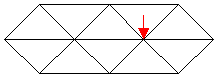
to a particular part of the tessellation. For example, use lots
of coloured tiles to build a pattern like this:
At the point marked by the arrow you could try asking questions
like:
- If I took out one of the triangles, how do I know which way
it fits in to make the tessellation?
- Why won't it fit if the triangle is rotated?
This should prompt your pupils into considering the angles
within the individual shape itself, which can be extended to
discussion about the sum of the angles at the point shown. This
work can make a lovely display!
Possible extension
You could also challenge the children
to make tessellating patterns using more than one type of shape.
Possible support
If there are children who are finding
this activity difficult, give them plenty of time to manipulate
the shapes practically.