$12$ pieces are used- $3$ different types of corner pieces,
side pieces could be $4$ different types, and $5$ for the
middle.
Unfortunately Shayan didn't give any
further explanation.
Jimmy and Meg, from Mrs Luke's class,
started out by working out how many different ways there were
of making jigsaw pieces only by removing buttons, and not
adding any.
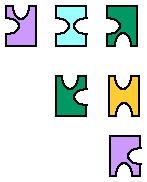
There is one piece with no holes in.
There are four pieces with one hole in, because there are four
sides so there are four ways we can take a hole out of one side
to make one piece. If the holes are in the middles of the
sides, so the piece is symmetric, then we can rotate the two
yellow pieces so they are the same and we can rotate the two
blue pieces so they are the same.
There are six pieces with two holes in. First we take a hole
out of the left side, and then we can take a hole out of any
other of the three sides. That makes three pieces. Then we take
a hole out of the top side and then we can take a hole out of
the right side or the bottom side, but not the left side
because we already made that piece earlier. That makes five
pieces. Then we take a hole out of the right side and the
bottom side. That makes six pieces. We have taken a hole out of
each side three times altogether.
If the holes are in the middles of the sides, we can rotate the
two purple pieces so they are the same and the two green pieces
so they are the same. We can flip over the purple pieces so
they are the same as the green pieces.
There are four pieces with three holes in. We make each piece
by leaving one side alone and making holes in the other three
sides, and because there are four sides we can do this four
different ways. If the holes are in the middles of the sides,
we can rotate the two yellow pieces so they are the same and
the two black pieces so they are the same.
There is one piece with four holes in.
We made 16 pieces. If we do not count things we can rotate to
be the same, we made 9 pieces. If we do not count things we can
rotate or flip to be the same, we made 8 pieces.
Well done, Meg and Jimmy. This is
fantastic - I like the system you've used to get all the pieces
with holes.
Jenny, from Mrs Luke's older class,
spotted a way to use Jimmy and Meg's work to see how many
pieces there were in total. Jenny again uses a very systematic
way of working. Even if you didn't get this far, you may be
able to understand some of Jenny's working and see which of her
shapes you did find yourself.
I looked at the edges that didn't have buttons taken out of
them. I could either leave them alone or add a button to them.
I could not take a button out because Jimmy and Meg had already
counted all the ways to do that. If there was one free edge, I
could make two different pieces (one with a button and one
without a button).
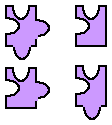
If there were two free edges, I could make four different
pieces. I could make one with no buttons, one with two buttons,
one with a button on one edge and one with a button on the
other edge, like this:
If there were three free edges, I could make eight different
pieces. I could pick one side and make that flat, and then I
could make four different pieces with the other two free sides,
like I did in my picture. Then I could make the first side I
picked have a button, and then there would be another four
different pieces I could make with the other two free sides.
That makes eight.
If I had four free edges, I could make sixteen different pieces
because that's the same as the number of pieces Jimmy and Meg
made taking different buttons out, and I am doing the same
thing as them only putting buttons in.
For each number of buttons taken out, I worked out the total
number of pieces I could make. This was the number of ways of
taking that number of buttons out times by the number of ways
of adding new buttons when you have taken that number of
buttons out. This is because for each way you take the buttons
out, you can make all the different new pieces by adding
buttons.
This did not work for when there were four buttons taken out.
(You're on the right track! Perhaps if
you think of "Number of ways of adding new buttons" as "Number
of things you can do either adding buttons or leaving things
alone" you'll see why.)