Congratulations for your solutions to Hyeyoun Chung, age 17, St
Paul's Girls' School, London; Royce Ferguson; Ang Zhi Ping, age
16; Yatir Halevi, age 17, Maccabim and Reut High-School, Israel;
and Joe Nielson, Rowan Maclennon-Ryde and Elizabeth Brewster from
Madras College, St Andrew's, Scotland.
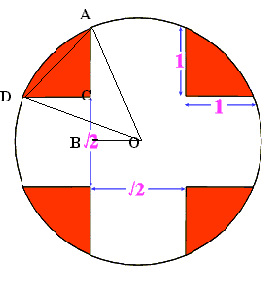
The radius of the circle OA can be found by using the right
triangle formed by AB = (1 + (√2)/2) and BO = (√2)/2). Using Pythagorus' theorem, the radius is found to be OA = √(2 +√2) units and the area of the circle to be π(2+ √2).
Now, connect the centre of the circle to the 8 points on it's
circumference where the white meets red. This divides the white
into circular sectors and quadrilaterals.
Using the cosine rule to find ∠AOD we have AC=CD=1 and
so AD = √2 and hence
cos∠AOD =
OA2 + OD2 −AD2
2OA.OD
=
1
√2
.
Hence ∠AOD = 45 degrees.
The area of the triangle AOD is
1
2
OA ×OD ×sin∠AOD =
√2
4
(2 + √2).
To find the area of the minor segment AD we subtract the area of
triangle AOD from the area of sector AOD which gives
π
8
(2 + √2) −
√2
4
(2 + √2).
To get the total red shaded area we now add the area of triangle
ACD and multiply by 4 which gives: